
Key Takeaways
- If you’re patching the same roof every quarter, you’ve already spent more than a replacement would have cost you two years ago. Chronic leaks, blistering membranes, and spiking utility bills all point the same direction.
- The roofing material you pick will either save you money for 25 years or cause headaches for 10. Houston’s heat and hurricane season narrow your options more than most building owners expect — TPO, EPDM, metal, and BUR all behave differently here.
- Don’t just budget for the membrane. Factor in tear-off labor, new insulation (it’s almost always needed), permits, code upgrades your building may have been grandfathered out of, and a contingency for whatever’s hiding under the old roof.
When Does a Commercial Roof Actually Need Replacing?
We had a property manager in Westchase call us last spring — third leak in four months, all in different spots. He’d been patching with a handyman crew for two years straight. When we got up there and pulled a core sample, the insulation was saturated across about 60% of the roof. At that point, repairs aren’t saving money. They’re delaying an inevitable bill that keeps growing.
Understanding Commercial Roof Replacement Houston
That’s the real question with commercial roofs: is this a fixable problem, or are you throwing good money after bad? Here’s how we figure that out during an inspection.
Age and Wear That Can’t Be Reversed
Most commercial roofing systems are engineered for somewhere between 15 and 30 years. TPO and EPDM typically land in the 15-25 range. Metal can push past 40. But those numbers assume the roof was installed correctly and maintained along the way — and in Houston, “maintained” means dealing with pooling water, UV degradation that’s relentless eight months a year, and the occasional hurricane that tests every seam on the building.
When we see widespread membrane cracking, seam separation that’s not limited to one area, or blistering across large sections — that’s not wear you can reverse. That’s a system that’s done. We’ve tried to extend roofs that are in this condition and the math never works. You end up spending 40-50% of replacement cost on repairs that buy you maybe two more years.
Structural Red Flags
The obvious sign is water inside the building. Stained ceiling tiles, dripping onto inventory, puddles on the warehouse floor after a storm. But what actually keeps us up at night is the damage you can’t see from inside — saturated insulation boards that have doubled in weight, rusted metal decking underneath, rotted wood nailers around the perimeter. This is particularly relevant for commercial roof replacement houston projects in the Houston area.
We pull core samples on every commercial inspection. Literally cut a small square out of the roof and look at what’s underneath. If the insulation is wet, spongy, or compressed flat, that section has to come out no matter what we do with the membrane on top. You can’t put a new roof over wet insulation. Well, you can — we’ve seen it done — but you’ll be calling someone again in three years when mold starts growing and the new membrane fails from underneath.
Your Energy Bills Are Telling You Something
Houston building owners are already fighting high cooling costs eight months out of the year. When a roof loses its reflective properties or the insulation underneath degrades, your HVAC system has to work harder. We’ve had warehouse owners tell us their electric bills dropped 15-20% after a roof replacement — mostly because the old insulation was shot and the new TPO membrane was actually reflecting heat instead of absorbing it.
If your cooling costs have been creeping up and nothing else has changed, get the roof inspected. It might not be the HVAC system that needs work.
Commercial Roofing Materials That Actually Work in Houston
Not every material belongs on every building here. Houston’s combination of brutal sun exposure, high humidity, heavy rain events, and occasional hurricane-force winds creates a specific set of demands that some systems handle better than others. Here’s what we install and when we recommend each one. For commercial roof replacement houston in Houston, this factor plays a significant role in project outcomes.
TPO (Thermoplastic Polyolefin)
TPO is our most-installed commercial membrane, and there’s a straightforward reason. The seams are heat-welded — no adhesives that can fail in humidity, no tape that peels after a few years. When you run a hot-air welder along a TPO seam, you’re fusing two pieces of plastic into one continuous sheet. That’s why TPO holds up so well in wind-driven rain. This is an important factor for commercial roof replacement houston projects.
White TPO reflects a significant amount of solar radiation, which matters when your roof surface hits 160°F+ in July. It’s also the most cost-effective single-ply option, typically running $6 to $10 per square foot installed depending on insulation thickness and project complexity. We install 60-mil as our standard and recommend 80-mil for roofs with heavy equipment or regular foot traffic.
EPDM (Rubber Roofing)
EPDM has been around forever and there’s a reason it hasn’t gone away — it handles temperature swings well and lasts a long time. The catch for Houston? Standard black EPDM absorbs heat like crazy. On a 95-degree day, a black EPDM roof can hit 170°F at the surface. White EPDM exists but it’s less common and costs more. Honestly, for most Houston commercial buildings, we steer people toward TPO unless there’s a specific reason EPDM makes sense — like a building with very few roof penetrations and simple geometry where fewer seams means fewer potential problems.
Standing Seam Metal
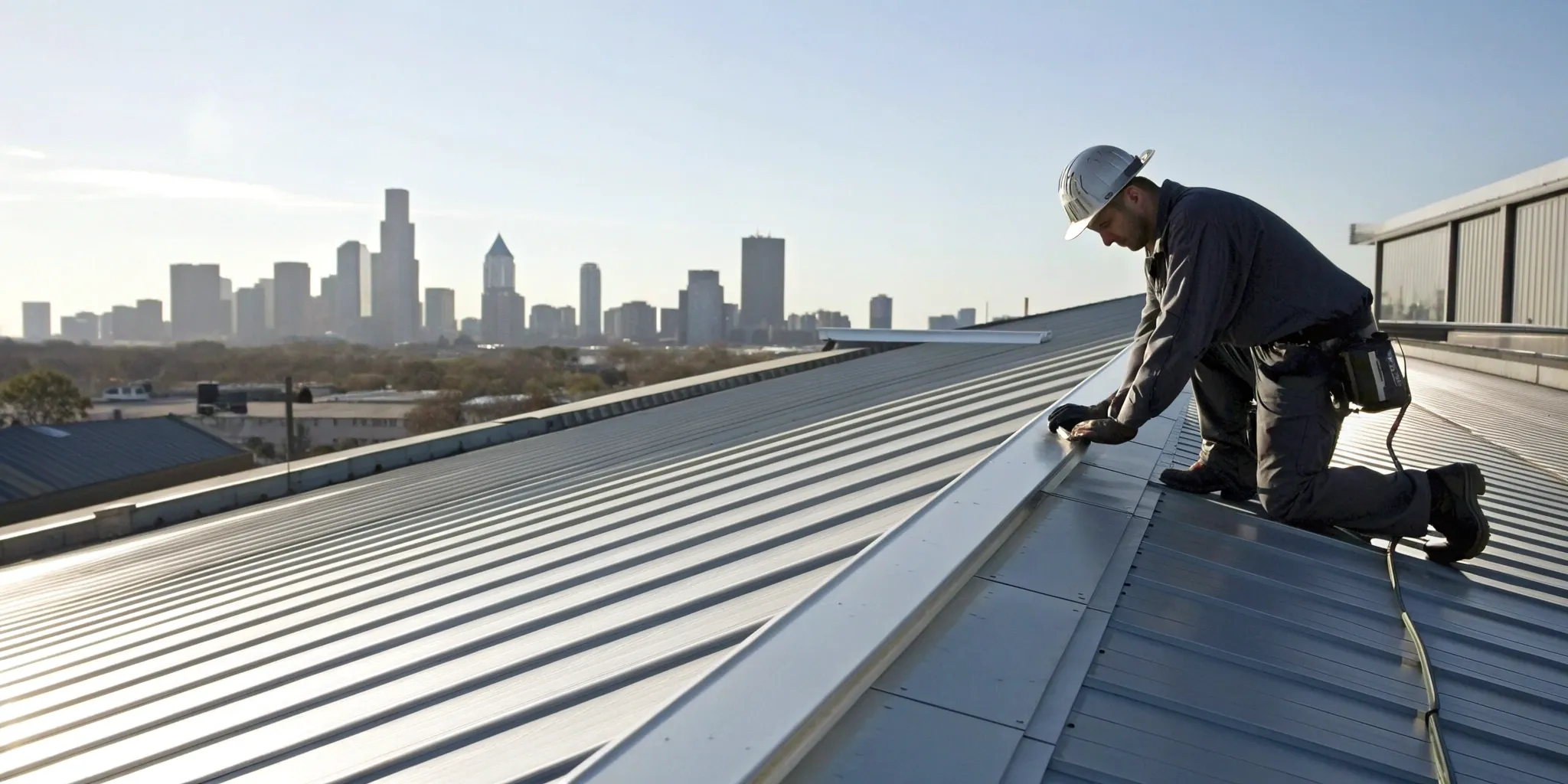
When longevity is the priority, metal wins. Period. A properly installed standing seam roof can run 40 to 60 years with basic maintenance. The concealed fastener design means there’s nothing exposed for wind to grab — we’ve seen metal roofs ride through Cat 2 hurricanes with zero damage while the TPO roof next door lost entire sections. Houston building owners considering commercial roof replacement houston should keep this in mind.
The trade-off is cost. Metal roofs run $10 to $18 per square foot installed, sometimes more depending on gauge, panel profile, and how complicated your roof geometry is. For a 20,000 sqft warehouse, that’s a meaningful difference from TPO. But amortized over 50 years instead of 20? The math often favors metal. We break this down for every client so the decision is based on real numbers, not gut feel.
Built-Up Roofing (BUR)
BUR is the “old school” option — alternating layers of asphalt and reinforcing fabric, topped with gravel or a cap sheet. It’s been around over a century because it works, plain and simple. The multi-layer construction provides redundancy that single-ply systems don’t have — if something breaches the top layer, there are still layers underneath.
BUR isn’t going to win any awards for energy efficiency, and installation is messier and slower than rolling out TPO. But for certain applications — heavy industrial buildings, roofs with lots of equipment traffic, buildings where the owner wants maximum puncture resistance — BUR still has a place. Cost falls in the $7 to $12 per square foot range.
What a Commercial Roof Replacement Costs in Houston
There’s no single number because every building is different. A 10,000 sqft office building with easy access and a simple roofline is a completely different job from a 50,000 sqft warehouse with 40 HVAC units on the roof and limited staging area. But I can break down the main cost drivers so you know what you’re looking at before we even get to a quote. This is a key consideration when evaluating commercial roof replacement houston options in Houston.
Material Costs
The membrane is just one piece. You’re also paying for insulation — polyiso is standard, and thicker insulation means better energy performance but higher cost. Then there’s cover board, fasteners, flashing materials, edge metal, sealants, and detail accessories around every penetration. On a typical Houston commercial job, materials run 35-45% of the total project cost. For commercial roof replacement houston, this consideration matters significantly.
Labor and Project Variables
Tear-off labor is a real cost that some quotes try to bury. Removing an old roof, hauling it off, and disposing of it properly adds $1 to $2 per square foot. If your roof has multiple layers (we see this a lot on older buildings), tear-off cost goes up. Access matters too. A ground-level building with an empty parking lot for staging is a faster job than a multi-story building in a tight downtown lot. Crane lifts for materials add cost but sometimes they’re the only option.
Houston permitting adds time and cost. The city requires permits for commercial re-roofs, and if your building is in a windstorm-designated zone, there’s an additional inspection process for TWIA certification. We handle all of this, but it’s built into the project timeline and budget.
Insurance and Financing Options
If storm damage triggered the replacement, your commercial property insurance should cover part or all of the cost. We work with adjusters regularly and document everything — photos, moisture readings, core sample results, material specifications. Good documentation is the difference between a smooth claim and a drawn-out fight. Understanding this helps Houston property owners make informed commercial roof replacement houston decisions.
For replacements that aren’t insurance-related, financing is available. We partner with commercial financing providers who offer terms that make sense for building owners. Most of our clients who finance are looking at monthly payments that are less than what they were spending on annual repairs — which makes the decision easier.
Picking the Right Contractor (Without Getting Burned)
Look, there’s no shortage of roofing contractors in Houston. After every hailstorm, the number seems to triple overnight. Some are legitimate operations with crews, equipment, and insurance. Some are a guy with a truck and a subcontractor list. Here’s how to tell the difference.
Questions Worth Asking
Don’t be shy about grilling your contractor. The good ones won’t mind — we actually prefer clients who ask hard questions because it means they care about the outcome. Ask these: How long have you been doing commercial work specifically? What manufacturer certifications do you hold? Can I see your certificate of insurance — the actual document, not just a “yeah we’re covered”? What does your warranty cover — just materials, or your workmanship too? Will you handle the permit and windstorm inspection, or is that my problem?
Checking Credentials
Texas requires roofing contractors to be registered with the state. That’s the bare minimum. Beyond that, look for manufacturer certifications — GAF, Carlisle, Firestone/Elevate, Polyglass. These aren’t just stickers on a truck. Manufacturers actually audit certified contractors, require ongoing training, and only let certified installers offer extended warranty programs. Anyone can buy TPO from a supply house and nail it down. But only a certified installer can give you the 20-year manufacturer warranty that actually means something. This is particularly relevant for commercial roof replacement houston projects in the Houston area.
Warranty Details Matter
Two things to look for: the manufacturer’s material warranty (typically 10-30 years on commercial systems) and the contractor’s workmanship warranty. The material warranty covers defects in the product itself. The workmanship warranty covers installation mistakes. You need both. A material warranty without a workmanship warranty is like buying a car with a powertrain warranty but no coverage for the mechanic who installed the engine backwards. Houston property owners evaluating commercial roof replacement houston should weigh this carefully.
Read the fine print on maintenance requirements. Most manufacturer warranties require annual inspections to stay valid. Skip the inspections and your warranty could be voided when you actually need it.
Red Flags to Watch For
Door-to-door solicitation right after a storm. Pressure to sign today or the price goes up. An estimate that’s dramatically lower than everyone else’s. These are all signs of a company that’s either cutting corners on materials, planning to surprise you with change orders, or won’t be around next year when you have a warranty claim. We’ve repaired plenty of roofs that were “replaced” by storm chasers two years earlier.
What Happens During the Replacement
Before Work Starts
We handle permitting with the City of Houston, coordinate with any HOA or property management requirements, and schedule the work around your business operations. If your building is occupied during the replacement — and most are — we plan the work in sections so there’s always a watertight condition maintained over the occupied areas. Nobody wants to come to work with a tarp over their desk. For commercial roof replacement houston in Houston, this factor plays a significant role in project outcomes.
Minimizing Business Disruption
We get that you can’t just shut down for two weeks. Most of our commercial replacements happen while the building is fully operational. We coordinate start times to avoid early-morning noise near offices, manage material staging to keep your parking lot functional, and keep walkways clear. Communication is the biggest thing — we give you a daily update on progress and a heads-up before anything loud is about to happen.
Taking Care of Your New Roof
A new commercial roof is a significant investment, and maintenance is what protects that investment. We recommend inspections at least once a year — twice is better — plus a check after any major storm. Annual maintenance means clearing drains and scuppers, checking seams and flashings for separation, looking at every pipe boot and curb flashing, and catching small issues before they become big ones. We offer maintenance programs for this exact reason — scheduled visits, written reports, and priority service if something needs attention between inspections.
Related RISE Roofing Services
Explore our related services: Commercial Roof Replacement, Commercial Roof Inspection, TPO Roofing, Roof Coating. Contact RISE Roofing at (832) 345-9527 for a free estimate.
Frequently Asked Questions
How long does a commercial roof replacement take?
Depends on the building. A straightforward 15,000 sqft re-roof with good weather might take 5-7 working days. A complex multi-story building with lots of equipment on the roof could take 2-3 weeks. Weather delays happen — this is Houston — so we always build buffer into the schedule. We’ll give you a realistic timeline during the estimate, not an optimistic one designed to close the sale. Houston building owners considering commercial roof replacement houston should keep this in mind.
Can I install a new roof over the existing one?
Sometimes. Building code generally allows up to two roofing layers. But just because you can doesn’t mean you should. If the existing insulation is wet or the deck has issues, covering it up creates bigger problems down the road. We check this during inspection and give you a straight recommendation — sometimes an overlay makes sense and saves real money, and sometimes it’s penny-wise and pound-foolish. When planning commercial roof replacement houston, keep this factor in mind.
What’s the best commercial roofing material for Houston?
We install TPO on more Houston commercial buildings than anything else because of its heat reflectivity, welded-seam durability, and cost-effectiveness. But “best” depends on your building. A restaurant with grease exhaust might need PVC. A warehouse that needs to last 50 years might justify metal. We’ll recommend the right system after looking at your specific roof — not before.
How much does it cost to replace a commercial roof in Houston?
Typically $5 to $12 per square foot installed, depending on the system, building size, tear-off requirements, and complexity. A 20,000 sqft building at $8/sqft is $160,000 — that’s a real number to plan around, but your actual cost could be higher or lower. Contact us for a free estimate specific to your property.
For more information about roofing standards and best practices, visit the National Roofing Contractors Association. This is a key consideration when evaluating commercial roof replacement houston options in Houston.