
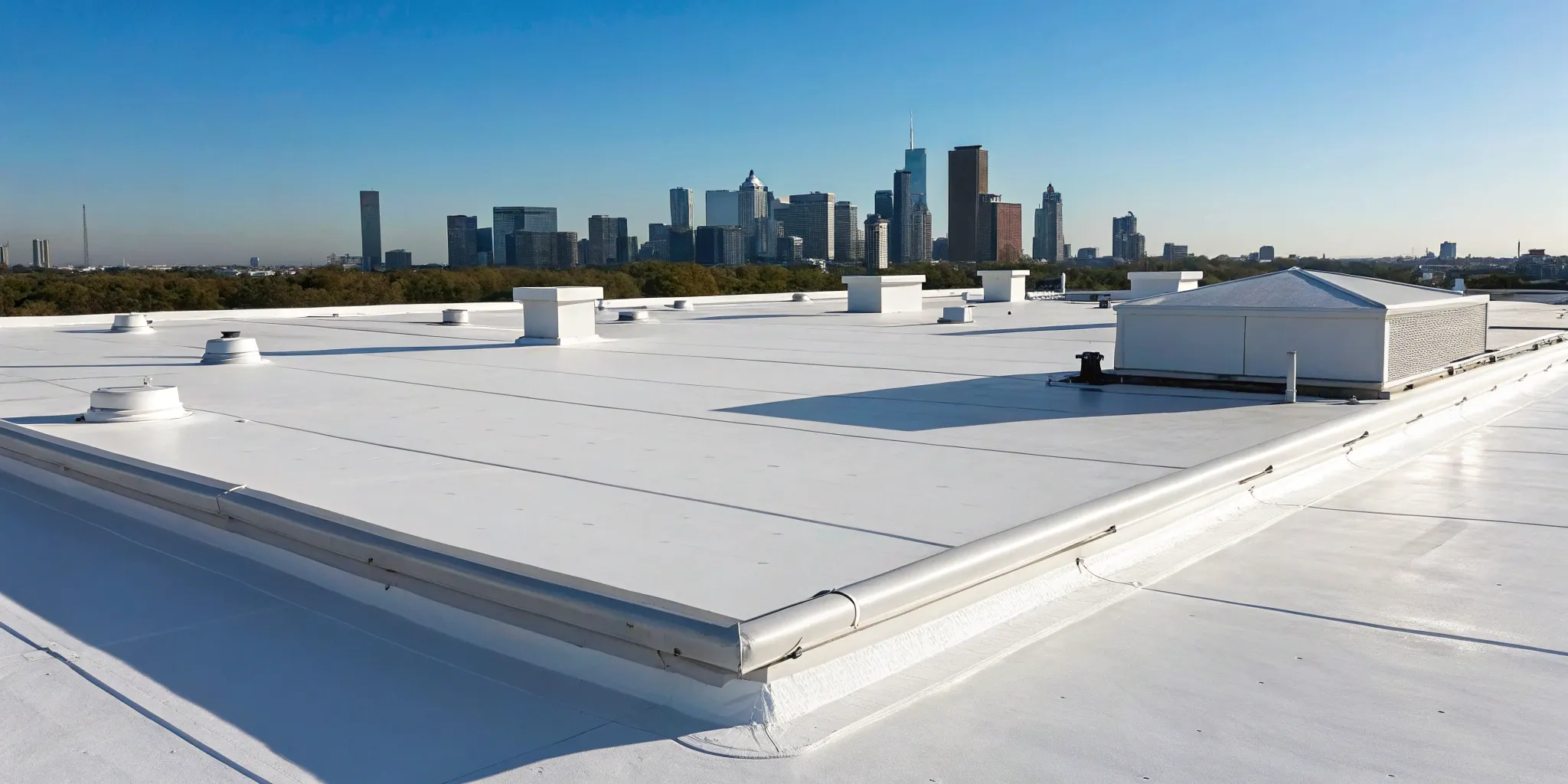
Looking for professional TPO roofing Houston installation? This comprehensive guide covers everything Houston building owners need to know about TPO roofing Houston costs, benefits, and contractor selection.
Key Takeaways
- TPO is the most-installed commercial membrane in Houston for good reason — heat-welded seams outperform adhesive-based systems in our humidity, the white surface cuts cooling costs meaningfully, and it’s the best value per square foot for flat and low-slope roofs.
- Installation method matters as much as the membrane itself. Mechanically attached is faster and cheaper. Fully adhered is quieter and handles wind better. The right call depends on your building’s wind zone, deck type, and budget.
- Not every roofer should install TPO. Heat-welding requires specific equipment and training. A bad weld looks fine on day one but fails in year two. Insist on manufacturer-certified installers who can back the work with an extended warranty.
Why TPO Works for Houston Commercial Buildings
We install more TPO than any other commercial membrane in Houston, and it’s not because we have some special arrangement with a TPO manufacturer. It’s because TPO genuinely solves the specific problems that Houston commercial roofs face — extreme heat, high humidity, heavy rain, and the occasional hurricane that tests every seam on your building.
Understanding Tpo Roofing Installation Houston
What TPO Actually Is
TPO stands for Thermoplastic Polyolefin, but the name doesn’t tell you much. In practical terms, it’s a single-ply membrane — a sheet of reinforced plastic that comes in rolls, typically 10 feet wide. You roll it out across the roof, overlap the edges, and fuse them together with a hot-air welder. That weld is what makes TPO different from older single-ply systems. You’re not relying on adhesive tape or glue to keep water out. You’re melting two pieces of plastic into one continuous sheet. In Houston’s humidity, where adhesives can take days to cure properly, that welded seam is a massive advantage.
Why It Suits Houston’s Climate
White TPO reflects roughly 80% of solar radiation. On a July afternoon when air temp hits 98°F, a black EPDM roof surface can reach 170°F. White TPO on the same building might hit 110-115°F. That 55-60 degree difference at the roof surface translates directly to less heat entering the building and less work for your HVAC system.
We’ve had warehouse owners in the Greenspoint area tell us their electric bills dropped 15-20% after switching from old built-up roofing to TPO. Some of that is the new insulation underneath, but the reflective membrane is doing real work. In a city where air conditioning runs 9 months a year, that’s not a trivial savings.
The Financial Case
TPO typically costs $6 to $10 per square foot installed — less than PVC, less than metal, and comparable to EPDM with better energy performance. When you factor in the cooling savings and the 15-25 year lifespan (longer with maintenance), the total cost of ownership is hard to beat. For building owners who need a reliable roof without overbuilding for the budget, TPO is usually where we land. This is particularly relevant for tpo roofing installation houston projects in the Houston area.
What Happens During a TPO Installation
We’ve been asked to explain this process hundreds of times, so here’s the unvarnished version — what actually happens on your roof from the day we show up to the day we hand you the warranty paperwork.
Inspection and Assessment
Before we quote anything, we get on the roof. We’re looking at the existing membrane condition, checking for trapped moisture (we’ll pull core samples if the roof is suspect), measuring the deck type and condition, cataloging every penetration — HVAC units, pipe boots, drains, vents, skylights. Each one of those is a detail that has to be flashed correctly or it becomes a leak in year two.
We also note access — where we can stage materials, whether we need a crane for rooftop equipment, and what sections of the building can be worked on simultaneously versus sequentially. All of this feeds the estimate and the project schedule. This is an important factor for tpo roofing installation houston projects.
Installation Methods
There are two primary ways to attach TPO to a commercial roof, and they’re not interchangeable. The right method depends on your building. For tpo roofing installation houston in Houston, this factor plays a significant role in project outcomes.
Mechanically attached: The membrane is laid out, the overlapping edges are heat-welded, and plates-and-screws fasten through the membrane into the deck at specific intervals. This is faster, less expensive, and works well on steel decks. The tradeoff is that the fasteners create points of movement during wind events — the membrane “billows” slightly between attachment rows. In most Houston applications, this is fine. In high-wind zones along the coast, the engineering has to account for it with closer fastener spacing.
Fully adhered: The membrane is glued directly to the substrate (usually a cover board over insulation) with bonding adhesive. No mechanical fasteners penetrating the membrane. This creates a smoother, quieter roof with better wind uplift performance. It costs more and takes longer because the adhesive needs proper conditions to cure — and Houston’s humidity makes that tricky. On mornings with heavy dew, we can’t start adhesive application until surfaces dry. That said, for buildings in high-wind areas or where noise from membrane flutter matters, fully adhered is the better system.
Walk-Through and Handoff
After installation, a project manager walks the entire roof with you or your facility manager. We check every weld with a probe tool, inspect all flashings and terminations, verify drain flow, and document the completed work with photos. You get a binder with the manufacturer warranty, our workmanship warranty, the maintenance schedule, and the as-built documentation. If your building needs a windstorm inspection, we coordinate that as a separate step.
Choosing a TPO Contractor in Houston
TPO installation looks simple from a distance — roll out sheets, weld the seams, done. But the number of TPO roofs we’ve been called to repair within 3-5 years of installation tells a different story. The failure is almost never the membrane. It’s the installation. Seams welded too fast (not enough heat penetration). Flashing details around HVAC curbs that were improvised instead of following manufacturer detail drawings. Fastener patterns that don’t match the wind zone engineering. This stuff matters, and you can’t tell from the ground whether it was done right. Houston building owners considering tpo roofing installation houston should keep this in mind.
Certifications That Count
The TPO manufacturers — GAF, Carlisle, Firestone/Elevate, Polyglass, Johns Manville — all run certification programs for commercial installers. These aren’t optional courses you take online. They involve hands-on training, equipment inspections, and periodic audits. More importantly, only certified installers can offer the manufacturer’s extended warranty programs. An uncertified contractor can buy the same TPO from a supply house, but your warranty options are limited to the basic material warranty — which doesn’t cover installation errors.
We carry certifications from every major TPO manufacturer we install. That’s not marketing — it’s the difference between a 10-year material-only warranty and a 20-year NDL (no dollar limit) warranty that covers both material and labor. For tpo roofing installation houston, this consideration matters significantly.
Insurance and Warranty Verification
Same rules as residential, but the stakes are higher on a commercial building. Ask for general liability ($2M+ for commercial work), workers’ comp, and an umbrella policy. Get the actual certificates. On the warranty side, you want the contractor’s workmanship warranty in writing — separate from the manufacturer warranty. If the installer goes out of business, the manufacturer warranty still exists, but the workmanship coverage walks out the door with them. Pick a company that’s been around long enough that you trust they’ll still exist in 10 years.
TPO-Specific Experience
Ask how many TPO roofs the crew has installed. Not the company. The crew that’ll be on your building. A company might have done 500 TPO installs, but if the crew they send to your job has done 20, that’s what matters. Ask to see photos of completed TPO projects — especially the detail work around penetrations, curbs, and perimeter edge. That’s where skill shows up. Any crew can roll out field sheets. Flashing is where the quality separates. This is a key consideration when evaluating tpo roofing installation houston options in Houston.
What TPO Costs in Houston
Per Square Foot Pricing
For a complete TPO system (tear-off, insulation, membrane, flashings, edge metal) in the Houston market:
- 45-mil TPO: $5.50–$8.00/sqft. We rarely recommend 45-mil anymore except for very low-traffic roofs with minimal mechanical equipment. It’s thinner, more susceptible to puncture, and the cost difference from 60-mil is usually under $1/sqft.
- 60-mil TPO: $6.50–$10.00/sqft. Our standard recommendation for most Houston commercial buildings. Good balance of durability, warranty options, and cost.
- 80-mil TPO: $8.00–$12.00/sqft. Premium option for high-traffic roofs, buildings with heavy rooftop equipment, or owners who want maximum longevity. 80-mil also qualifies for the longest manufacturer warranty terms.
These ranges cover the full installed system, not just the membrane. Insulation type and thickness, attachment method, number of penetrations, and building access all move the number within those ranges.
What Drives the Price Up or Down
The biggest variable we see is insulation. A 2-inch polyiso board costs less than half of what a 4-inch board costs — but the thicker insulation dramatically improves energy performance and is often required by current energy code. If your building was last re-roofed before the 2015 energy code update, you’re almost certainly looking at an insulation upgrade.
Other factors: roof access (crane lifts for materials on multi-story buildings add $1-3K), tear-off complexity (multiple existing layers, wet insulation that has to be removed), total number of penetrations requiring custom flashing, and whether the building is in a TWIA wind zone that requires specific attachment engineering and post-install inspection. Understanding this helps Houston property owners make informed tpo roofing installation houston decisions.
Financing
A commercial roof is a capital expenditure, and not every building owner has $80,000-$200,000 sitting in reserve. We work with commercial financing partners who structure loans specifically for building improvements — fixed rates, terms that match the expected roof lifespan, and monthly payments that are often less than what the owner was spending on annual repair costs. If financing makes the difference between replacing a failing roof now versus patching it for two more years, it’s usually the smarter move financially. Houston property owners evaluating tpo roofing installation houston should weigh this carefully.
TPO Material and System Options
Membrane Thickness
The three standard TPO thicknesses are 45-mil, 60-mil, and 80-mil. Thicker membrane means better puncture resistance, longer life expectancy, and access to longer warranty terms. We default to 60-mil on most Houston commercial projects. It handles foot traffic from maintenance workers, resists puncture from wind-blown debris, and qualifies for 20-year warranty programs from most manufacturers. 80-mil is the move for roofs with frequent HVAC service traffic, rooftop solar installations, or building owners who want the maximum warranty available.
Attachment Methods
We covered this above, but the short version: mechanically attached is faster and cheaper, fully adhered performs better in high wind and makes less noise. There’s a third option — ballasted TPO, where the membrane is loose-laid and weighted down with river rock or pavers. We don’t recommend ballasted systems in Houston. The added weight strains the structure, the ballast makes leak detection nearly impossible, and during a hurricane, loose gravel becomes airborne shrapnel. It’s an older method that’s fallen out of favor for good reasons.
Insulation Under TPO
The insulation under your TPO membrane does as much for energy performance as the reflective membrane on top — maybe more. Polyisocyanurate (polyiso) is the standard for commercial flat roofs. It comes in rigid boards in thicknesses from 1.5″ to 4″+, and the R-value per inch is the highest of any commonly used roof insulation. This is particularly relevant for tpo roofing installation houston projects in the Houston area.
Current Houston energy code requires a minimum R-value that usually means at least 3″ of polyiso for a roof replacement. If your building was roofed before 2015, you’re almost certainly upgrading insulation as part of any re-roof — and that’s actually a good thing. The energy savings from proper insulation thickness usually cover the cost difference within a few years.
We also install tapered insulation systems on buildings with ponding water problems. Tapered polyiso creates slope where the deck is flat, directing water toward drains instead of letting it pool. Ponding water is the single biggest enemy of any flat roof — it accelerates membrane degradation, adds weight to the structure, and creates leak pathways if any seam or flashing imperfection exists. Solving the drainage issue during a re-roof is always cheaper than dealing with the consequences of ignoring it.
How TPO Handles Houston Weather
Heat and UV
Houston roofs take more UV punishment per year than almost any city in the northern hemisphere. That UV breaks down roofing materials — it’s why old shingles lose granules and old EPDM gets chalky and brittle. TPO is formulated with UV stabilizers that resist this degradation, and the white surface means the membrane absorbs less heat to begin with. We’ve pulled off 18-year-old TPO membranes that still had measurable flexibility and intact seam welds. That’s not guaranteed across every brand and installation, but it demonstrates what quality TPO can do in this climate. When planning tpo roofing installation houston, keep this factor in mind.
Wind and Storms
During Hurricane Beryl in 2024, we inspected dozens of TPO roofs across the Greater Houston area. The ones that were engineered correctly — proper fastener spacing for the wind zone, adequate perimeter and corner securement, metal edge details that were mechanically attached and sealed — came through with zero issues. The ones that were installed with minimum-code fastener patterns or had edge metal that was face-nailed instead of cleated? Some lost sections. For tpo roofing installation houston in Houston, this factor plays a significant role in project outcomes.
The lesson is that TPO’s wind performance is a function of the installation design, not just the membrane itself. We engineer every commercial TPO roof to the specific wind zone, building height, and exposure category. For buildings in TWIA-designated areas along the coast, we design to the stricter TDI requirements and coordinate the WPI-8 inspection.
Rain and Moisture
Houston gets 50+ inches of rain annually, often in concentrated bursts that dump 4-6 inches in a few hours. TPO’s heat-welded seams are inherently waterproof — unlike mechanically fastened metal or adhesive-bonded EPDM, there’s no seam material that can degrade or separate under water exposure. The critical detail is drainage. A perfectly welded TPO roof that holds standing water will still fail eventually — ponding water accelerates UV degradation (the water acts as a magnifying lens), adds structural load, and creates conditions for biological growth that can damage the membrane surface.
Common TPO Problems and How to Prevent Them
Seam Failures
When a TPO seam fails, it’s almost always an installation defect, not a material defect. The welder was set too cold (under-welded — the seam looks fused but pulls apart under stress), too hot (the membrane gets thin and brittle at the seam), or moved too fast (inconsistent weld width). We test every seam with a probe after welding. If it peels, we re-weld. That 30 seconds of testing saves thousands in leak repairs later.
Punctures
Dropped tools, HVAC service techs dragging equipment, foot traffic in the same path every week — all of these create puncture risk. Thicker membrane helps (80-mil versus 45-mil is a significant difference in puncture resistance). Walk pads in high-traffic areas around rooftop equipment add protection where it’s needed most. We include walk pads in our standard scope for any roof with regular service traffic. Houston building owners considering tpo roofing installation houston should keep this in mind.
Ponding Water
Already mentioned above, but it bears repeating: ponding water is the number one preventable failure on flat commercial roofs in Houston. If your current roof has areas where water sits for 48+ hours after rain, address that with tapered insulation or cricket details during the re-roof. Don’t just put new membrane over the same drainage problem and expect a different result.
Maintaining Your TPO Roof
Inspection Schedule
Minimum twice a year — once in spring before storm season, once in fall after it. Plus after any significant weather event. This isn’t optional maintenance. Most TPO manufacturer warranties require documented inspections to remain valid. Skip the inspections and your 20-year warranty effectively becomes a piece of paper. This directly impacts tpo roofing installation houston outcomes and long-term value.
During inspections, we check seam integrity, flashing condition around every penetration, drain flow, edge metal attachment, membrane surface condition (looking for punctures, abrasion wear, discoloration that suggests chemical exposure), and overall drainage patterns. Everything gets documented with photos and a written report.
Cleaning and Repairs
TPO roofs don’t need regular washing in most cases. Exception: if your building is near a freeway overpass or industrial facility that deposits particulates on the roof surface, annual cleaning helps maintain reflectivity. We use low-pressure washing with manufacturer-approved cleaning solutions — never a power washer, which can damage the membrane surface. This is a key consideration when evaluating tpo roofing installation houston options in Houston.
Small repairs — a puncture from a dropped tool, a seam that needs re-welding at a specific spot — are straightforward on TPO. The same hot-air welder used during installation makes field repairs. We can patch a puncture in under an hour and restore the waterproof integrity completely. The key is catching problems early. A puncture that’s found during inspection is a $200 repair. A puncture that goes unnoticed for two years and lets water saturate the insulation underneath is a $15,000 section replacement.
TPO vs. Other Commercial Roofing Systems
TPO vs. EPDM
EPDM is cheaper per square foot, but the seams are adhesive-bonded — and in Houston’s humidity, adhesive performance is a legitimate concern. Black EPDM also absorbs far more heat than white TPO, which drives up cooling costs. Where EPDM still makes sense: very simple roof geometry with minimal penetrations, where fewer seams means fewer potential failure points. For most Houston commercial buildings, TPO’s welded seams and reflective surface make it the better choice.
TPO vs. PVC
PVC and TPO are more similar than different — both are heat-welded single-ply systems with good reflectivity. PVC’s advantage is chemical resistance, particularly to animal fats and petroleum-based compounds that can degrade TPO. If your building is a restaurant, food processing facility, or has rooftop exhaust from chemical processes, PVC is worth the 15-20% premium. For everything else, TPO gives you equivalent seam performance at a lower price point.
TPO vs. Metal
Completely different products solving different problems. Metal lasts 40-60 years; TPO lasts 15-25. Metal costs roughly double upfront. Metal handles wind better (no membrane to uplift). TPO is faster to install and easier to repair. For building owners making a 20-year decision, TPO is usually the right call. For owners who want one roof for the next half-century and can absorb the upfront cost, metal wins. We install both and recommend based on the owner’s actual situation, not a preference for one material over another. Understanding this helps Houston property owners make informed tpo roofing installation houston decisions.
Related RISE Roofing Services
Explore our related services: TPO Roofing, Commercial Roof Coating, PVC Roofing, Commercial Inspection. Contact RISE Roofing at (832) 345-9527 for a free estimate. For anyone researching tpo roofing installation houston, this is essential information.
Frequently Asked Questions
How long does a TPO roof last in Houston?
15 to 25 years is the realistic range, depending on membrane thickness, installation quality, maintenance consistency, and storm exposure. 60-mil TPO with annual inspections and good drainage typically hits the upper end. 45-mil with deferred maintenance and ponding water problems might not make 15.
How long does TPO installation take?
For a typical 15,000-25,000 sqft commercial building: 5-10 working days depending on tear-off scope, weather conditions, and complexity. Larger buildings or those with extensive rooftop equipment take longer. We provide a detailed timeline during the estimate and update you daily during the project.
Can TPO be installed over my existing roof?
Sometimes. If the existing insulation is dry and the deck is sound, a TPO overlay can work and saves the cost of tear-off. But we need to verify this with core samples and moisture testing. If there’s trapped moisture, an overlay traps the problem underneath and the new membrane fails prematurely. We’ll give you a straight recommendation — overlay when it makes sense, tear-off when it doesn’t. This is particularly relevant for tpo roofing installation houston projects in the Houston area.
Is TPO or PVC better for Houston?
TPO for most buildings. PVC if your building has chemical or grease exhaust exposure. Both are heat-welded single-ply systems with strong seam performance. TPO costs less and reflects equally well. The decision comes down to chemical exposure, not climate.
Does a TPO roof require special maintenance?
Not special — but consistent. Twice-yearly inspections, keeping drains clear, addressing punctures promptly, and maintaining documentation for warranty purposes. TPO is genuinely low-maintenance compared to BUR or modified bitumen systems, but “low maintenance” doesn’t mean “no maintenance.”
How much can I save on energy with a TPO roof?
Building owners in Houston typically report 10-25% reductions in cooling costs after switching to reflective TPO from dark-membrane systems. The exact number depends on your building’s insulation, HVAC efficiency, and how much of the building’s thermal envelope is the roof (single-story buildings see the biggest impact). We’ve seen warehouse electric bills drop by $800-$1,500/month after a TPO install — numbers that significantly offset the roof investment over its lifespan. This plays a key role in successful tpo roofing installation houston projects.
For more information about roofing standards and best practices, visit the NRCA.
TPO Roofing Houston: Why Choose RISE Roofing
For TPO roofing Houston projects, RISE Roofing delivers certified installation with manufacturer warranties. Our TPO roofing Houston team handles commercial flat roofs across the greater Houston area. Contact us for a free TPO roofing Houston estimate today.