When a hailstorm rolls through the Houston metro, the damage to your roof is rarely obvious from the driveway. RISE Roofing provides fast, thorough hail damage roof repair across Houston and the Gulf Coast — with free inspections and honest photo documentation for your insurance claim, from first call to final nail.
Hail damage roof repair restores a roof after hailstones bruise shingles, knock off protective granules, and dent metal flashing, vents, and gutters. In the Houston area, most sudden hail damage qualifies for a homeowners insurance claim — and Texas homeowners typically pay only their wind/hail deductible. RISE Roofing inspects your roof for free, documents every impact for your claim, and manages the repair or full replacement through completion.
Hit by hail? Start here.
Call (832) 224-3435 for a free hail damage roof inspection in Houston. We document all damage for your insurance claim — no cost, no obligation.
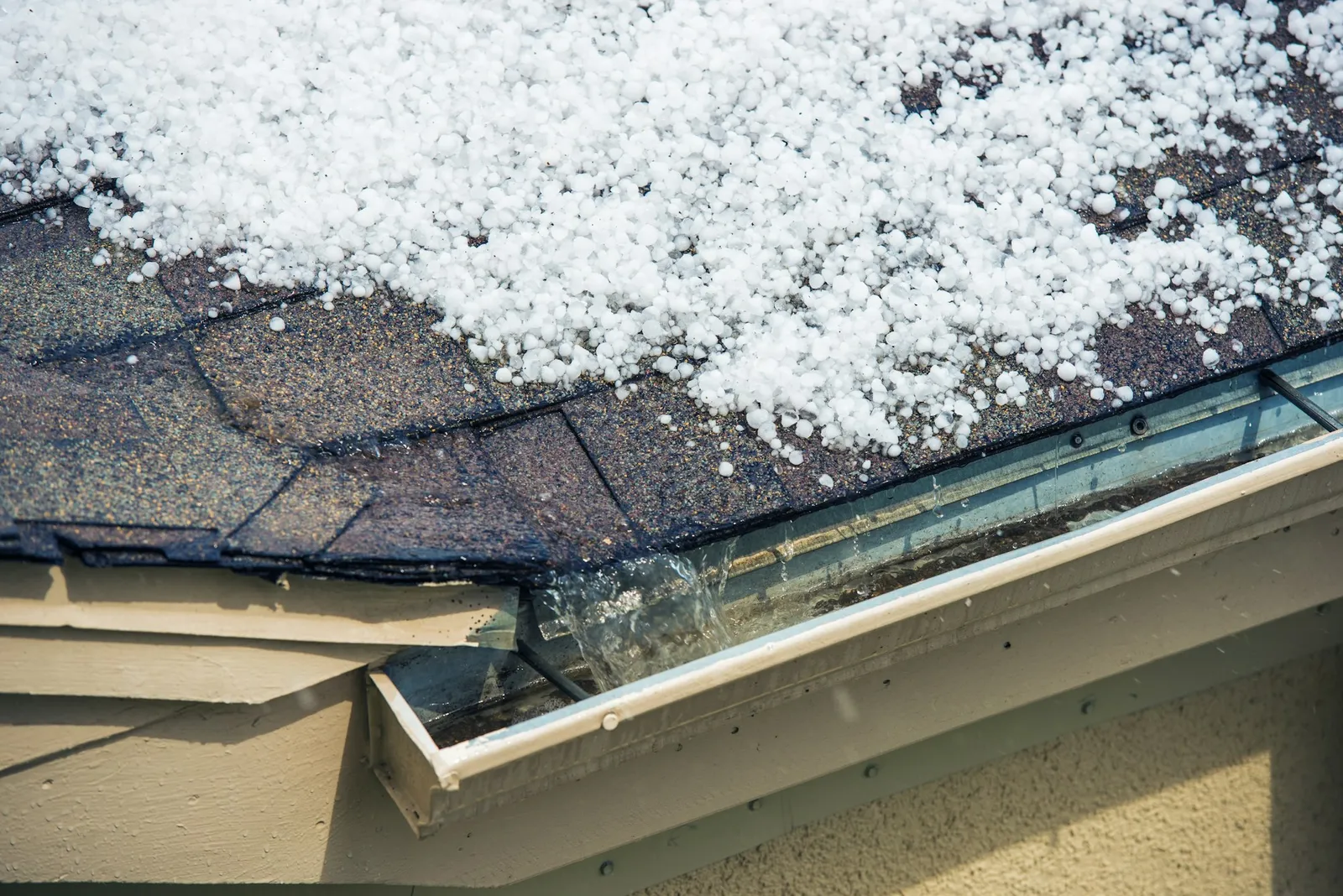
Hail forms inside severe thunderstorm updrafts — the stronger the updraft, the larger the stone. The National Weather Service classifies hail one inch (quarter-sized) or larger as severe, and stones around that size are enough to damage standard asphalt shingles. Texas consistently ranks among the top states in the country for hail damage insurance claims, and the Greater Houston area — including Harris, Fort Bend, and Montgomery counties — sees several significant hail events in a typical storm season.
On an asphalt shingle roof, each impact knocks the protective mineral granules loose, exposing the asphalt mat underneath to the sun. That accelerated UV aging shortens the roof's life long before you ever see a leak. Hail also fractures and cracks shingles, leaves soft "bruises" where the mat has been compromised, and dents metal flashing, vents, gutters, and roof accessories. On a metal roof, heavy hail dents panels and can chip the protective coating, opening the door to corrosion in Houston's humid, salt-tinged Gulf air.
Much of the damage is not visible from the ground, which is why a professional inspection after any storm with one-inch-plus hail is the safest move. Watch for these warning signs:
Because water intrusion can begin promoting mold growth within roughly 24 to 48 hours, catching hail damage early protects both your claim and your home. If you have an active leak right now, see our emergency roof repair service.
Step 1 — Free hail damage inspection. We examine the full roof surface, gutters, flashing, and attic, then document every impact with dated close-up photos. You get a written assessment whether or not you file a claim.
Step 2 — Claim documentation. If the damage is claim-worthy, we pair our documentation with the storm date and hail-size data insurers look for, so it is ready when you file.
Step 3 — Adjuster visit. Your insurance company sends an adjuster to inspect the roof; you can share our photos and written assessment with them.
Step 4 — Repair or replacement. For isolated damage we complete targeted repairs; for widespread damage we handle a full roof replacement with manufacturer-certified materials and a price-locked, written scope.
Step 5 — Final walkthrough. We confirm the work and clean up every nail and shingle fragment. On replacement-cost policies, your insurer releases the recoverable depreciation once the work is finished.
Most Texas homeowners policies cover sudden hail damage, and you generally pay only your wind/hail deductible — commonly 1–2% (sometimes higher) of your dwelling's insured value. In Texas, hail and wind claims generally must be filed within one year of the date of loss under your policy's terms, and state law requires insurers to acknowledge your claim within 15 business days. Filing sooner, while the damage is fresh and well documented, almost always produces a stronger outcome.
Under a replacement cost value (RCV) policy, your insurer pays the actual cash value first and releases the recoverable depreciation once the repair or replacement is finished. For a full walkthrough, read our roof insurance claim guide. Homeowners in the designated coastal counties who carry wind and hail coverage through the Texas Windstorm Insurance Association (TWIA) should review those requirements as well, since the claim process differs.
When hail is covered by insurance, your out-of-pocket cost is usually just the deductible. Still, it helps to understand the underlying numbers. The national ranges below are typical starting points — use our roof cost calculator for a Houston-specific estimate, and the ACV calculator to gauge an age-adjusted insurance payout.
| Scenario | Typical U.S. Range |
|---|---|
| Minor / isolated repair (a few shingles, flashing) | $400 – $1,500 |
| Moderate repair (one slope, multiple areas) | $1,500 – $4,000 |
| Full asphalt shingle replacement (avg. home) | $4 – $7 / sq ft (~$8,000 – $16,000) |
| Class 4 impact-resistant upgrade | ~10 – 25% more than standard shingles |
| Your out-of-pocket on a covered claim | Wind/hail deductible (often 1–2% of insured value) |
As a rule of thumb, we repair when the damage is isolated (roughly under 20% of the roof) and the roof is relatively new. We recommend replacement when damage is widespread, the roof is already aging (often 15 years or older), or your claim covers a full replacement. If you're rebuilding after hail, it's the ideal time to upgrade to impact-resistant roofing. Class 4 products carry the highest impact rating under the UL 2218 standard (tested with a two-inch steel ball), and installing them may qualify you for a premium discount — each insurer sets its own discount amount and test criteria, so ask your carrier what yours offers. Options like stone-coated steel and standing seam metal shrug off future storms far better than standard shingles.
Most Texas homeowners policies cover sudden hail damage. You typically pay only your wind/hail deductible — commonly 1–2% of your dwelling's insured value. RISE Roofing documents the damage and provides a written repair estimate at no charge.
Look for granule buildup in gutters, dark bruises or soft spots on shingles, cracked shingles, and dents on metal flashing, vents, and gutters. Much of the damage isn't visible from the ground, so schedule a professional inspection after any storm with one-inch-plus hail.
Texas law generally gives you up to one year from the date of loss, and insurers must acknowledge your claim within 15 business days. That said, filing within days to weeks — while the damage is fresh and documented — produces the strongest claim.
Yes. RISE Roofing provides free, no-obligation hail damage roof inspections across the Houston area, including dated photo documentation you can use directly for your insurance claim.
🔒 Free, no-obligation quote — Price-locked estimate in 24–48 hrs
Trace your roof on satellite imagery and get a real installed price in under 60 seconds.
Powered by satellite roof measurement technology. No obligation.