

This metal tile roof guide covers stone-coated steel made to look like Spanish and Mediterranean clay tile. A metal tile roof is steel panels with a stone-chip finish, pressed into tile shapes, with several tiles formed in each panel. So yes, there is a metal roof that looks like clay tile, and more than one maker sells it.
The guide walks through three profiles (panel shapes) we install: DECRA Villa Tile, DECRA Tile and Tilcor Antica. For each you get what its maker publishes on panel size or count, weight, minimum pitch, fastening and warranty, then how to tell whether a tile profile suits your roof. RISE Roofing installs every DECRA profile and every Tilcor profile.
The short version
- Three profiles. DECRA Villa Tile is barrel-style, DECRA Tile is scalloped, and Tilcor describes Antica as an S-tile shape.
- How they fasten. Villa Tile goes directly on the roof deck. DECRA Tile goes on battens (wood or steel strips). Tilcor’s Antica data sheet shows battens; its brochure says Tilcor profiles go over a counter batten system or direct to deck. RISE installs Antica direct to deck.
- Minimum pitch. 3:12 for all three in the makers’ documents: 3 inches of rise for every 12 inches of run.
- Weight. Villa Tile is listed at 130 to 160 pounds per square (100 square feet), depending on the document. One clay tile maker lists its tiles at approximately 590 to 1,070 pounds per square.
- Hail and wind. DECRA states UL 2218 Class 4, the top class in that impact test, for both tile profiles, and treats dents and granule loss as cosmetic. Its warranty’s 120 mph wind and 2.5 inch hail figures are tied to a manufacturing defect.
- Who installs it. RISE is certified with DECRA and Tilcor, and our certified installation crew has installed DECRA for over 20 years.
What metal roof tiles are and how they go on
These panels are stone-coated steel. DECRA’s blog explains the name: “Stone-coated metal roofing gets its name from its exterior coating. It’s made of steel sheets coated with stone granules.” DECRA forms its panels from steel with an aluminum-zinc alloy coating, and ICC Evaluation Service (ICC-ES) describes the finish on them as an acrylic base coat, embedded colored stone granules and a clear acrylic glaze. Our stone-coated steel roofing page covers the material itself.
Direct to deck means the panels screw straight to the roof deck, the plywood or solid sheathing over the rafters. A batten system puts a grid of wood or steel strips (battens) on the deck first, and the panels fasten to those. DECRA’s post comparing the two methods says “neither method is universally better than the other”.
For DECRA’s two tile profiles the method comes with the profile, and the two are covered by different ICC-ES evaluation reports. An evaluation report checks a product against named building codes and sets the conditions for installing it. ESR-1754 covers Villa Tile installed “directly on minimum 15/32-inch-thick (11.9 mm) plywood or on solid sheathing”. ESR-2901 covers DECRA Tile on battens.
The three profiles covered here have the same published minimum pitch, 3:12. DECRA’s Villa Tile guide specification (March 2024) says that between 2:12 and 3:12 “the metal roof panels are considered decorative and must be installed over a roof covering system in accordance with the local building code.”
DECRA’s panels can go over a single layer of existing asphalt shingles in many cases, and our guide to installing a metal roof over existing shingles has the conditions. In the Texas windstorm designated catastrophe area (14 coastal counties and parts of Harris County east of Highway 146) RISE requires a tear-off first. That is our own practice, not a rule of the Texas Department of Insurance, the Texas Windstorm Insurance Association or DECRA.
Where the numbers in this metal tile roof guide come from
The product figures come from the makers’ own documents, ICC-ES evaluation reports, the Cool Roof Rating Council’s directory and one tile-industry manual. Where those documents give different specification figures for a weight, we print each one with its document.
DECRA Villa Tile: the barrel-style Spanish profile
On its metal tile roofing page DECRA labels Villa Tile “Spanish-Style Barrel Tile” and says the line achieves “the classic look of semi-cylindrical Spanish tiles”. If you want a metal barrel tile roof, or a Spanish tile metal roof, this is DECRA’s version.
Villa Tile was introduced around 2007. That February the trade magazine Roofing Contractor reported: “A new Villa tile will be available this spring”.
Villa Tile specs, document by document
The table draws on DECRA’s guide specification (March 2024), its 2023 specifications sheet (the spec sheet), its Villa Tile installation guide (August 2023), its Lifetime Limited Warranty (October 2025) and ESR-1754 (reissued November 2025). Psf is pounds per square foot.
| Spec | What is published | Document |
|---|---|---|
| Steel thickness | 26 gauge (0.0179 inch). ICC-ES gives the coated steel as 0.017 inch. | Guide spec; ESR-1754 |
| Panel size | 17″ × 44¼″ | Guide spec; spec sheet; ESR-1754 |
| Installed exposure | 14½″ × 39½″, the part of each panel left showing | Guide spec; spec sheet; install guide; ESR-1754 |
| Panels per square | 25.2 | Spec sheet; install guide |
| Minimum pitch | 3:12 | Guide spec; spec sheet; install guide; ESR-1754 |
| Installed weight | 130 to 160 lb per square: 1.3 psf in ESR-1754 (one figure for all four profiles in that report), 150 lb in the guide spec, 160 lb on the spec sheet and in the install guide | Each as named |
| Fastening | Direct to the roof deck. The install guide requires one layer of underlayment, the water-resistant layer under the roof covering. | Guide spec; install guide; ESR-1754 |
| Impact rating | UL 2218 Class 4, as DECRA states it. ESR-1754 does not evaluate impact. | Guide spec; code compliance sheet (November 2025); hail bulletin |
| Warranty | Lifetime Limited on a single-family detached home: “for the lifetime of the Owner while the Owner owns the dwelling.” Its remedy covers labor and materials for the first 20 years after installation, then materials only on a prorated basis. | Warranty |
| Wind and hail, in the warranty | Repair or replacement, at the company’s option, where a manufacturing defect “results in blow off of panels as components of the Roof System by winds of up to 120 mph (193 kph)” or “results in damage to the Roof System caused by the penetration of hailstones of 2.5 inches (6 cm) or less completely through the Roof System” | Warranty |
Class 4 is the top class in UL 2218. DECRA’s hail bulletin (undated; the file dates from April 2020, before the current warranty) describes its test: a 2-inch steel ball dropped on the panel twice in the same spot. That is a test result, not a promise against dents: the same bulletin says a dent or granule loss at the impact site “is considered aesthetic and not a functional damage warranty claim.” The warranty’s wind and hail figures apply to a manufacturing defect, and it adds: “This Limited Warranty is NOT a guarantee of performance.” For warranty terms, rely on the October 2025 warranty, not the older bulletin.
DECRA Tile: the scalloped Mediterranean profile
DECRA labels DECRA Tile “Mediterranean-Style Scalloped Tile”. Its figures below come from the DECRA Tile guide specification (March 2024), the 2023 specifications sheet and ESR-2901 (reissued September 2025 and marked “Subject to renewal September 2026”).
Villa Tile vs DECRA Tile
The two differ in shape, panel size and how they fasten.


| Spec | DECRA Villa Tile | DECRA Tile |
|---|---|---|
| Shape | Barrel-style | Scalloped |
| Fastening | Direct to deck | On battens |
| Panel size | 17″ × 44¼″ | 16½″ × 52″ |
| Installed exposure | 14½″ × 39½″ | 14½″ × 50″ |
| Panels per square | 25.2 | 20 |
| Installed weight | 130 to 160 lb per square, by document | 150 lb per square; approximately 1.5 psf in ESR-2901 |
| Minimum pitch | 3:12 | 3:12 |
DECRA’s guide specification gives DECRA Tile the same 26 gauge steel and the same UL 2218 Class 4 statement as Villa Tile, and the same Lifetime Limited Warranty terms apply.
Tilcor Antica: Tilcor’s Spanish-tile-style profile
Tilcor’s Antica product page headlines Antica “The graceful style of the Mediterranean” and says it lets you “achieve the Spanish Tile style”. Tilcor’s 2021 Antica flyer calls the panel’s form an “S-tile shape”.
The product page lists 21 tiles per square (each tile is one panel) and a minimum roof pitch of 3/12. Tilcor’s published specifications give the weight as about 132 to 150 lb per square: 132.28 lb on the flyer, 133 lb on the product page and 150 lb installed in its May 2023 brochure, which also gives the gauge as 26.
On fastening, Tilcor’s Antica data sheet shows four nailing points per tile into battens, and the brochure describes Tilcor profiles as installed “over a counter batten system or direct to deck”. RISE installs Antica direct to deck. If you are comparing quotes, ask which method each one uses.
Tilcor and DECRA are sister brands owned by IKO. IKO’s July 2025 press release on its plant in Ennis, Texas says the plant makes “stone-coated metal roofing in tile, shake, and shingle profiles under the DECRA® and Tilcor brands.” DECRA’s ICC-ES reports still name Corona, California as the place of manufacture. Tilcor’s US Lifetime Limited Warranty (March 2026) uses the same 120 mph and 2.5 inch manufacturing-defect wording as DECRA’s.
If one of these three profiles is on a quote you are weighing, our DECRA roofing in Houston page shows the DECRA line we install. Or call RISE Roofing at (832) 224-3435. We are open 24/7.
Other makers’ Spanish-style profiles
Other makers sell Spanish-style steel profiles too. Westlake Royal Building Products’ Unified Steel Stone Coated Roofing line includes BARREL-VAULT Tile, which Westlake’s product page describes as resembling “the authentic look of traditional Spanish Tile”. We do not install Westlake’s stone-coated steel.
Metal tile vs clay or concrete tile
The difference the documents settle is weight. Clay tile maker US Tile lists its tiles in its guide specification (March 2023) from approximately 590 lb per square for its lightweight tile to approximately 1,070 lb for a two-piece tile.
The Tile Roofing Industry Alliance’s installation manual for concrete and clay tile (March 2024) defines a standard-weight tile as “Roof tile of mass/unit area of 9 lbs/ft2 or greater installed weight excluding all other roofing components.” That is 900 lb per square or more. Villa Tile is listed at 130 to 160, DECRA Tile at 150 and Antica at about 132 to 150.
Steel panels put less load on the framing than real tile does, but no document here says what your framing can carry; that question matters most when the roof you are weighing is the heavier one.
If you want real tile, see our clay tile roofing page. In the City of Houston, replacing real clay or concrete tile with steel means a tear-off: the city’s residential code, as written, does not permit new roofing over existing clay or cement tile. Other cities adopt their own editions, so confirm with your permit office.
Is a tile profile right for your roof?
Check five things.
- Pitch. All three profiles need at least 3:12. Check the flattest part of the roof, not only the main slopes.
- Roof shape and trim. Hips and ridges (the roof’s outside corners and peaks), eaves, valleys and side walls each take their own trim pieces: DECRA’s Villa Tile installation guide shows separate ones for each, plus a Villa Tile panel vent. More of them means more pieces and more cuts.
- Style of the house. The makers’ labels say it: Spanish for Villa Tile, Mediterranean for DECRA Tile, both words for Antica. If a tile shape does not suit your house, DECRA’s Shingle XD and its shake profiles are the alternatives: see metal roofing that looks like shingles and stone-coated steel with a wood shake look.
- Foot traffic. DECRA’s installation guides are written for installers; what they say is not a reason to go up yourself. The Villa Tile installation guide says: “Foot traffic on Villa Tile Panels should be kept to the tile pans or low points, not on the high points.” The Tile and Shake installation guide (August 2023) has its own foot-traffic note for DECRA Tile, which adds where to walk on a batten installation. DECRA’s warranty excludes “damage caused by improper foot traffic”, so make sure anyone who has to go on the roof knows where to step.
- Color and heat. The Cool Roof Rating Council (CRRC) directory lists four DECRA colors for Villa Tile and DECRA Tile: Spanish Clay, Royal Oak, Sicilian Sand and Mist Grey. Their initial solar reflectance, a 0-to-1 measure of how much sunlight a surface reflects, runs from 0.21 to 0.31 in listings approved in 2020 and 2021. None of the colors shown on DECRA’s tile page is among them, so if a rated color matters to you, ask whether one of these four is offered in the profile you want. CRRC says of a rating: “it does not indicate a ranking or approval.”
What drives the cost of a metal tile roof
Five things move the quote.
- Profile. Villa Tile takes 25.2 panels per square, DECRA Tile takes 20 plus its battens, and Antica takes 21.
- Roof complexity. A steep pitch, valleys, dormers and skylights mean more cuts, more flashing and more time.
- Tear-off or over the shingles. Tear-off and disposal are a line on the quote. An install over existing shingles skips the full tear-off.
- Underlayment. In ESR-1754 the roof’s fire classification depends on which underlayment or barrier board goes under the panels, so ask which one is on your quote.
- Trim and color. Trim pieces and vents are separate items from the panels. DECRA’s cool-color flyer says: “Additional charges may apply to Cool Colors.”
For numbers, our stone-coated steel roofing cost page covers pricing and the roof cost calculator gives a starting estimate. RISE offers financing through Acorn Finance, a third-party lender. Financing spreads the cost; it does not lower it. Details are on our roof financing page.
RISE Roofing: certified with DECRA and Tilcor
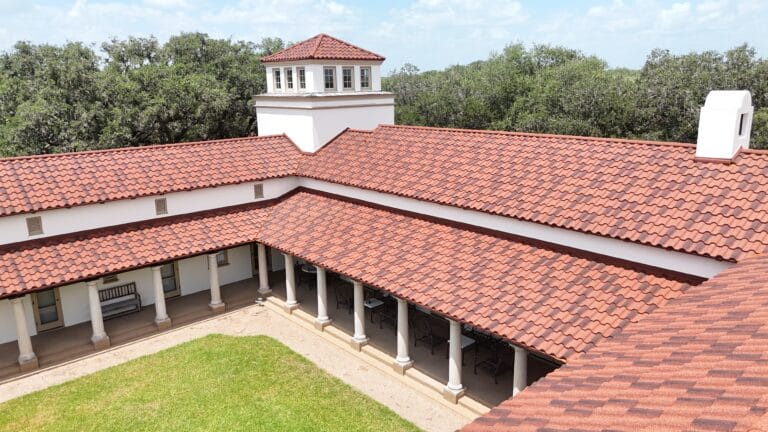
RISE Roofing is certified with DECRA and Tilcor and installs every profile both brands make. Our certified installation crew has installed DECRA for over 20 years. The aerial photos on this page show a DECRA Villa Tile roof we installed on a ranch in Refugio, Texas. That roof was a finalist for DECRA’s 2025 Project of the Year. Tile profiles are one part of our metal roofing in Houston lineup.


If this metal tile roof guide has you leaning toward a tile profile, start with the roof you have: its pitch, its layers and its deck. Call RISE Roofing at (832) 224-3435 or request a free estimate.
Frequently Asked Questions
A metal tile roof is made of steel panels with a stone-chip finish, pressed into tile shapes, with several tiles formed in each panel. DECRA and Tilcor both make them. Depending on the profile, the panels fasten straight to the roof deck or to strips called battens, and the three profiles in this guide all need a roof pitch of at least 3:12.
Yes. DECRA labels Villa Tile a Spanish-style barrel tile, and Tilcor describes Antica as the Spanish tile style in an S-tile shape. DECRA Tile is the scalloped profile that DECRA labels Mediterranean-style. All three are stone-coated steel panels, and RISE Roofing installs every DECRA profile and every Tilcor profile.
Shape, panel size and fastening. Villa Tile is the barrel-style profile and fastens directly to the roof deck. DECRA Tile is the scalloped profile and fastens to battens. DECRA’s documents give Villa Tile panels as 17 by 44-1/4 inches at 25.2 panels per square, and DECRA Tile panels as 16-1/2 by 52 inches at 20 per square. A square is 100 square feet. Both have a 3:12 minimum pitch.
There is no single number, because the price depends on the roof. The profile, how cut-up the roof is, whether the old roof is torn off or the panels go over existing shingles, the underlayment and the trim pieces all move it. Our stone-coated steel roofing cost page covers pricing, and our roof cost calculator gives a starting estimate for your roof.
DECRA’s installation guides are written for installers; what they say is not a reason to go up yourself. The Villa Tile installation guide says foot traffic should be kept to the tile pans or low points, not the high points, and to avoid walking on the side laps where panels overlap. DECRA’s warranty excludes damage caused by improper foot traffic, so make sure anyone who has to go on the roof knows where to step.
DECRA Villa Tile, DECRA Tile and Tilcor Antica all have a published minimum pitch of 3:12, a roof that rises 3 inches for every 12 inches of horizontal run. Between 2:12 and 3:12, DECRA’s Villa Tile specification treats the panels as decorative, to be installed over a roof covering that meets the local building code. Check the flattest part of your roof, not only the main slopes.
Sources
DECRA: Metal Tile Roofing product page; Villa Tile Roof Panels and Tile Roof Panels guide specifications (March 2024); Specifications Sheet (2023); Villa Tile and Tile and Shake installation guides (08/23); Code Compliance and Testing sheet (11.17.25); Hail: Understanding Impact Resistance (undated; file dated April 2020); Lifetime Limited Warranty (10/2025); cool roof colors flyer; blog posts on stone-coated metal roofing and on battens versus direct-to-deck; ICC-ES Evaluation Reports ESR-1754 (reissued November 2025) and ESR-2901 (reissued September 2025; marked “Subject to renewal September 2026”); Tilcor: Antica product page, Antica flyer (2021), brochure (May 2023), Antica technical data sheet and US Lifetime Limited Warranty (03/2026); Cool Roof Rating Council, Rated Products Directory; Roofing Contractor, DECRA Celebrates 50 Years of Strength (February 5, 2007); IKO press release on its Ennis, Texas plant (July 16, 2025); US Tile clay roofing tile guide specification (03/23); Tile Roofing Industry Alliance, Concrete and Clay Roof Tile Installation Manual (March 2024; read from the copy hosted by Westlake Royal Building Products); Westlake Royal Building Products, Barrel-Vault Tile product page; City of Houston residential code and the Texas Department of Insurance description of the windstorm area, both as quoted in our metal roof over shingles guide. All read October 2, 2026. ICC-ES states that its evaluation reports are not to be construed as “an endorsement of the subject of the report or a recommendation for its use”. Makers revise these documents, so confirm current figures before you rely on them.