Every part of your roof, explained in plain English.
When a roofer walks your estimate or an adjuster writes your claim, they'll use terms most homeowners have never had to learn. This glossary breaks a roof into its four working systems — structure, weatherproofing layers, ventilation, and drainage & penetrations — and defines each part in plain English so you can read a quote with confidence. For how these parts go together on your home, see roof system components.
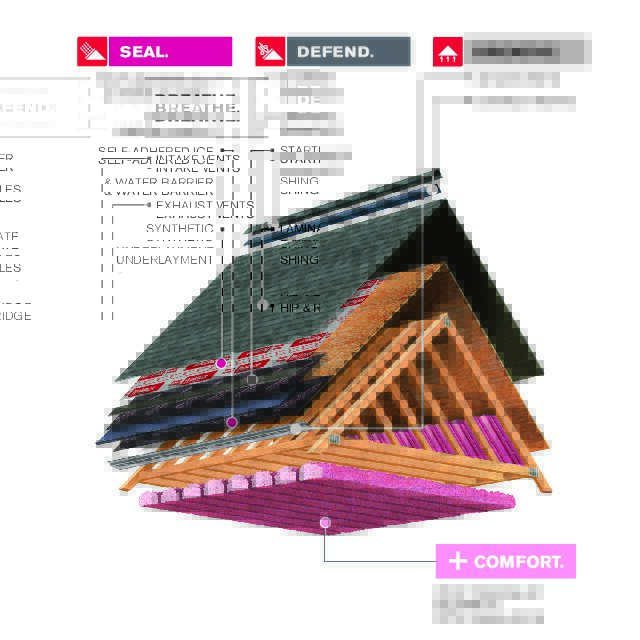
The angled framing members that carry the roof's weight down to the walls. Rafters are cut on site; trusses are pre-engineered. You rarely see them once the roof is on, but they set the roof's shape and pitch.
The layer of plywood or OSB nailed across the rafters — the surface everything else is fastened to. A roof is only as strong as its deck, which is why we re-nail decking to current high-wind standards during a replacement.
The horizontal line at the very top where two roof planes meet — the peak. It's capped with special hip & ridge shingles and usually holds the ridge vent.
An external angle where two roof planes meet and slope down — think of the corners of a pyramid-style roof. Hips shed water well but add cutting and waste.
The internal angle where two roof planes meet and channel water down and off the roof. Valleys carry the most water, so they get extra waterproofing (ice & water membrane) and are a common leak point when done poorly.
The lower edge of the roof that overhangs the exterior wall — where gutters attach. Because wind-driven rain attacks here, the eave gets starter strip and often ice & water shield.
The sloped edge of a gable roof, running from eave up to ridge. Rake edges need starter strip too, or wind can lift the shingles.
The water-resistant layer rolled over the deck before shingles go down — modern synthetic underlayment resists tears and UV far better than old felt. See our full roofing underlayment guide.
A self-adhering, waterproof membrane applied in the highest-risk zones — valleys, eaves, and around penetrations — that seals around nails to stop leaks from wind-driven rain.
A metal flashing along eaves and rakes that directs water off the roof edge and into the gutter instead of behind it — code-required and a frequent low-bid omission.
A special first course of shingles along eaves and rakes with a factory adhesive strip that locks down the edge against wind uplift. Skipping it (or flipping field shingles instead) voids most wind warranties.
The main shingles that cover the broad "field" of the roof — what most people picture as "the roof." Their coverage is measured in roofing squares.
Thicker, pre-bent shingles made to wrap over hips and the ridge. Color-matched caps rated for high wind are part of a proper system; bent field shingles used as caps crack and leak.
Metal pieces that seal the joints where the roof meets something else — walls (step & counter flashing), chimneys, and skylights. Most roof leaks trace back to failed or reused flashing, which is why we install new flashing on every replacement.
A low-profile vent that runs along the ridge to let hot attic air escape at the peak. Paired with intake vents, it's the exhaust half of a balanced system — details in our roof ventilation guide.
Vents in the underside of the eave overhang (the soffit) that pull cool air into the attic. Without intake, a ridge vent can't work — a critical detail in Houston's heat.
The balanced flow of intake (soffit) and exhaust (ridge) that keeps the attic cooler and drier. Good ventilation extends shingle life and lowers cooling bills; poor ventilation bakes shingles and can void the warranty.
The vertical board running along the eave that caps the rafter ends and holds the gutter. Rotted fascia is a sign of long-term water overflow.
The horizontal underside of the eave overhang, between the fascia and the wall. It usually houses the intake vents.
The seal around plumbing vent pipes that poke through the roof. Cheap rubber boots crack in Houston's UV within a few years — spun lead or metal boots last the life of the roof.
The flashing system that waterproofs where a chimney passes through the roof. A "cricket" is a small ridge built behind a wide chimney to divert water around it instead of letting it pool.
The channel at the eave and the vertical pipe that carry roof runoff away from the foundation — essential given Houston's rainfall totals.
These parts only protect your home when they're installed as one system to the manufacturer's spec — that's what separates a roof that lasts its full life from one that leaks early. Curious how long that is by material? See how long a roof lasts. Pricing a project? Try the roofing squares calculator and our roof replacement cost guide.
Have a question about any part of your roof? RISE Roofing gives free, no-pressure inspections across Greater Houston. Call (832) 224-3435.
🔒 Free, no-obligation quote — Price-locked estimate in 24–48 hrs
Trace your roof on satellite imagery and get a real installed price in under 60 seconds.
Powered by satellite roof measurement technology. No obligation.