What SRI Means for Your Roof
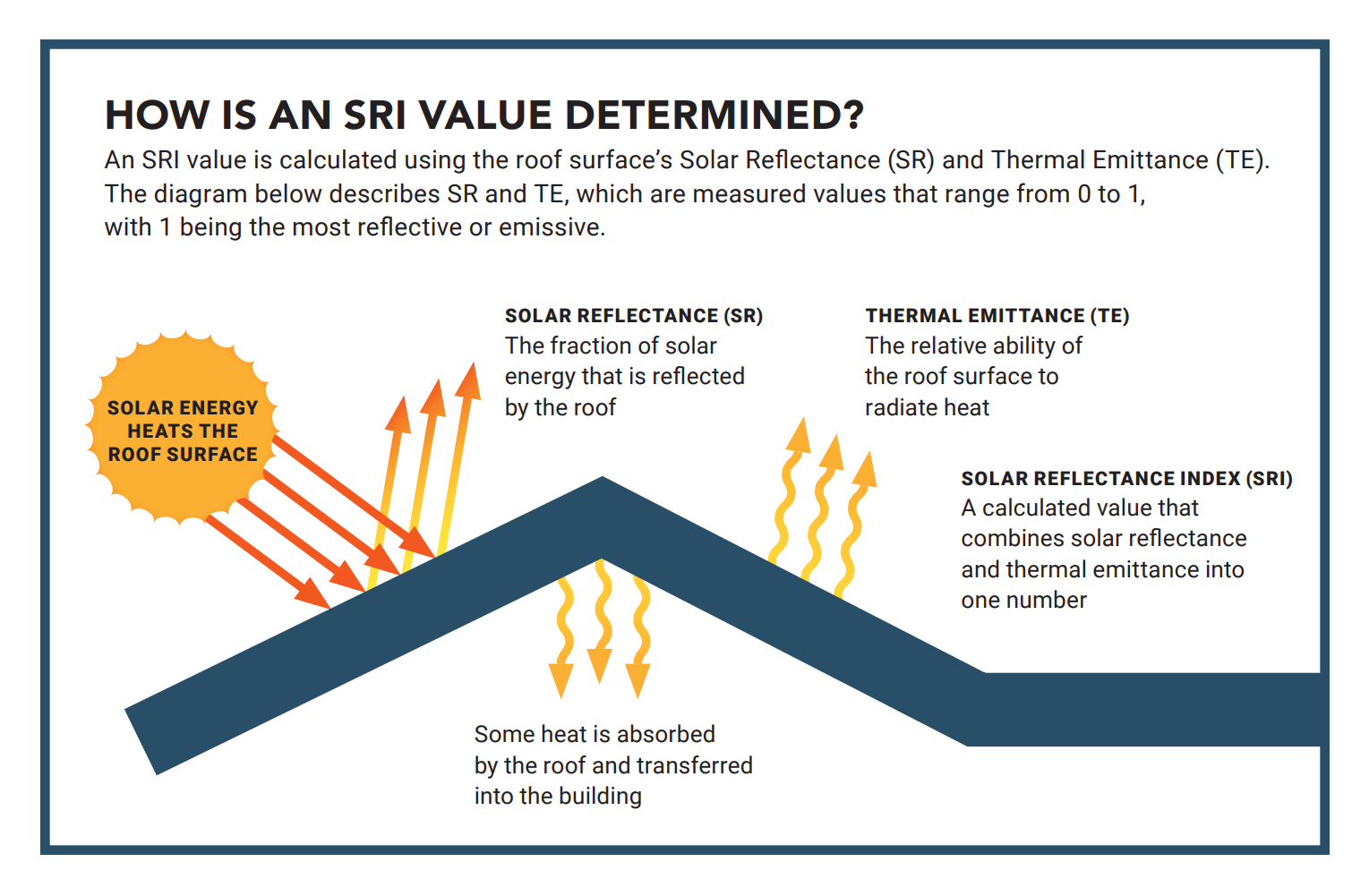
Solar Reflectance Index measures how well a roofing material rejects solar heat, on a scale where a standard black surface scores 0 and a standard white surface scores 100 (a few materials score below 0 or above 100). A standard black asphalt shingle scores about 0. A new white TPO membrane scores about 99, and about 85 after three years of weathering. The higher the number, the less heat your roof absorbs and transfers into your building.
In Houston, this isn’t academic. A roof with an SRI of 25 gets much hotter on a July afternoon than a roof with an SRI of 78 under the same conditions. That extra heat raises the cooling load on your building — and in a city with a cooling season as long as Houston’s, it adds up fast.
SRI by Roofing Material
White TPO/PVC membrane: SRI about 95-110 when new (white TPO about 99, white PVC about 108), settling to about 85 after three years of weathering. The top performer. This is why TPO dominates commercial flat roofing in Houston.
Light-colored metal (Galvalume, white Kynar): White and near-white Kynar (PVDF) finishes rate about SRI 73-86 when new. Unpainted Galvalume rates about 55-62 when new but loses much of that as it weathers (bare sheet falls to roughly 26-28). Standing seam metal with a white or near-white finish is one of the best-performing residential options.
Stone-coated steel (light colors): SRI about 28-45 (darker granule colors about 20-25). The ceramic granules reflect more than standard shingles but less than bare metal.
Architectural shingles (light colors): SRI about 15-33. Standard “cool color” shingle options from manufacturers such as Owens Corning improve on dark shingles but still absorb significant heat.
Dark asphalt shingles: SRI about 0-10 for standard colors (CRRC-rated “cool” dark shingles about 16-23). The worst performer. Common on older Houston homes and the reason many attics run so hot.
Why It Matters for Houston Buildings
Energy codes in Houston increasingly reference SRI for commercial roofing. The 2021 IECC requires cool roof materials on low-slope commercial roofs in Climate Zone 2 (which includes Houston). The minimum is a three-year-aged solar reflectance of 0.55 with thermal emittance of 0.75, or an aged SRI of 64, over air-conditioned space, with limited exceptions (for example, areas covered by solar panels or shaded by the building). In practice that means a white or near-white surface, such as white TPO, white PVC or white-painted metal, on most new low-slope commercial roofs; unpainted Galvalume and light-gray metal fall short.
For residential, there’s no SRI mandate yet. But choosing a higher-SRI material still pays off. The less heat the roof absorbs, the less of it your AC has to work to remove.
The Trade-Off
Higher SRI usually means lighter colors. Not every homeowner wants a white or light gray roof. The good news is that cool-roof technology is improving — Owens Corning now offers “cool color” shingles in medium and dark tones that score about SRI 15-24, versus roughly 0-10 for standard dark shingles. Not as good as metal, but a meaningful improvement.
Want to know the SRI of your current roof or compare options? Contact us and we’ll walk through the numbers for your specific situation.
Solar Reflectance Index (SRI)
SRI rates how well a roof keeps cool in the sun. It blends two lab-measured numbers: solar reflectance (R) – how much sunlight bounces off – and thermal emittance (E) – how quickly the surface re-emits heat. Higher SRI = cooler roof → lower attic temps & energy bills.
| Material | Solar Reflectance (R) | Thermal Emittance (E) | SRI |
|---|---|---|---|
| White TPO membrane | 0.79 | 0.90 | 99 |
| Cool-coated metal (light gray) | 0.41 | 0.86 | 45 |
| Unpainted Galvalume® | 0.68 | 0.10 | 56 |
| Charcoal asphalt shingle | 0.12 | 0.91 | 9 |
Estimate your roof’s SRI
*Typical initial (new-roof) values; individual products vary, and light-colored and bare-metal roofs lose reflectance as they weather. SRI is calculated per ASTM E1980 at medium wind speed, the same method the calculator uses. Sources: CRRC Rated Roof Products Directory, manufacturer data sheets and published lab measurements.