What the seam changes in wind, water and price, and which one fits your home.
Snap-lock vs mechanical seam is one of the first things to check when two standing seam quotes for the same house come back at different prices. From the street the roofs look alike. On one, the seams press together by hand. On the other, a machine folds every seam shut. The trade calls that one mechanically seamed or mechanical lock; some people say “mechanically fastened,” which should not be confused with exposed-fastener panels, where the screws show.
Both are real standing seam. We build mechanical seam on most Houston roofs because a mechanically seamed panel is usually rated higher for wind uplift with its hold-down clips the same distance apart, and its machine-folded seam is tighter, which matters most on low-pitch sections. Snap-lock is a sound, usually lower-cost choice when your main goal is the look.
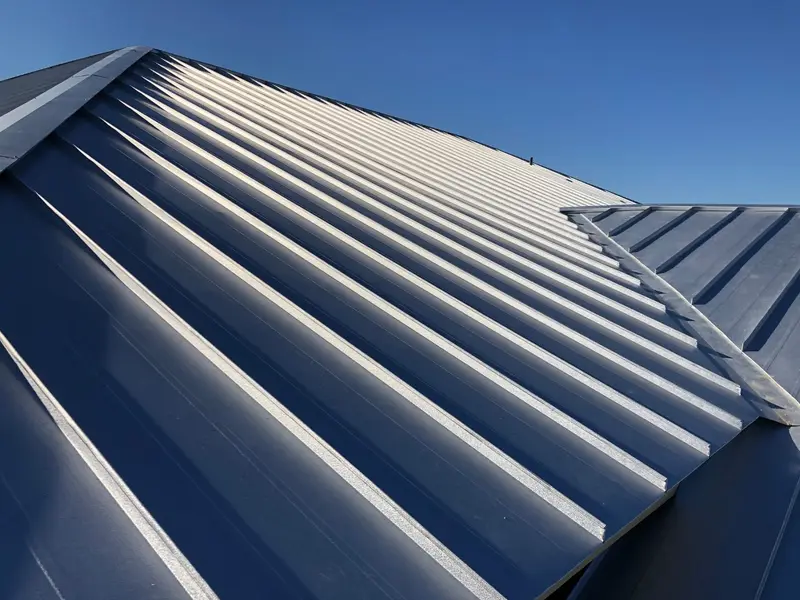
Snap-lock is a standing seam roof. “Snap-lock vs standing seam” is the wrong question: snap-lock is one way a standing seam is closed (see the different types of standing seam metal roof). Each panel presses onto the last over concealed clips, hidden anchors screwed to the roof deck. No seaming machine runs along the seam.
That skipped step is why it usually costs less. New Tech Machinery, whose roll-forming machines shape both kinds of panel, says: “Snap-lock is the more cost-effective option and is plenty sufficient in most situations.” The finished roofs look alike too. Western States Metal Roofing writes that “differences in appearance after installation are virtually undetectable” between them.
Sheffield Metals on snap-lock: “Not all snap-locks are engineered, which will vary by manufacturer, but many are tested and proven to perform with numerous material types and roof deck substrates.” Many snap-lock panels are covered by public windstorm evaluations of their own, and on either system the clips have to be spaced so that the panel’s listed rating covers the design wind load for the house.
Metal Sales, which makes both, sums up the split: “Snap Lock is typically best for cheaper installation costs, mild climates and high sloped roofs. Mechanically Seamed is typically best for a more secure fit, areas with extreme weather conditions and low sloped roofs.”
So snap-lock is the right buy when your main goal is the look at a lower price, every roof section is at or above the panel’s listed minimum slope (3:12 for most snap-lock panels: 3 inches of rise per 12 of run), and the house is inland, away from open water and the coast. We install it on those homes.
On a Gulf Coast roof we would rather spend the extra labor on the seam than discover the margin was thin.
Wind moving over a roof pulls up on it. That pull is uplift, measured in pounds per square foot (psf), and it is strongest at the edges and corners. Both systems are held down by concealed clips screwed to the roof deck, the plywood under the panels. A wind rating is the uplift a panel is listed to resist at a stated clip spacing, the distance between clips.
Companies that make or tool both systems say the seamed one generally resists wind better. McElroy Metal: “mechanically seamed panels generally provide enhanced resistance to wind uplift and water penetration compared to other standing seam attachment methods. This is why mechanically seamed systems are often specified for projects with higher wind requirements.” New Tech Machinery says “mechanical lock profiles work best on low slopes since they’re more water and wind-resistant, making them a popular choice in mountain and storm regions.” Both describe the category, not every panel.
The Texas Department of Insurance (TDI) publishes product evaluations for its windstorm program, and anyone can read them in the public listing. TDI’s product evaluations page states their purpose: “Inspectors, engineers, contractors, builders, and consumers use product evaluations to make sure the product comply with TDI adopted building specifications and to make sure they are installed properly to resist wind load.”
These are public records. The same page says “TDI does not approve the use of or endorse any product,” and each evaluation carries this line: “This product evaluation is not an endorsement of this product or a recommendation that this product be used.”
None of the evaluations discussed here belongs to RISE. The figures are not ratings for your roof or ours, and the counts are our own tally, not a TDI finding. We counted a panel as mechanically seamed or snap-lock only where its evaluation says how the seam is closed.
Here is how to read one. An evaluation for a metal roof panel names the panel, its gauge (metal thickness), its deck, and a design pressure in psf for each clip spacing. One evaluation current on October 1, 2026 lists another company’s 24-gauge panel on 15/32-inch plywood two ways: “snapped together (Unseamed)” in TDI’s words, and closed with a mechanical seamer to a 90-degree seam.
| How the seam is closed | 24-inch clip spacing | 12-inch clip spacing |
|---|---|---|
| Snapped together (Unseamed) | 56.0 psf | Not listed |
| Seamed to a 90-degree seam | 80.5 psf | 108.5 psf |
Same panel, same deck, same 24-inch clip spacing: closing the seam with the seamer raises the listed rating from 56.0 to 80.5 psf, about 44% higher, for that panel at that spacing only.
Across the wider set:
Three cautions. These are the evaluations TDI wrote itself, roughly half of the metal-panel evaluations it lists, not the whole market. Many reprint the same table, so the counts are of evaluations, not products. And the pattern holds usually, not always: the highest-rated clip-attached snap-lock panels reach about 112 to 113 psf at 12-inch spacing, and one maker’s snap-lock outrates one of its own mechanically seamed panels.
What to take from it. Seam type does not set the number by itself: clip spacing and the rest of the assembly do, and there is no fixed ratio between the two seam types. At the same clip spacing, though, the mechanically seamed panel is usually the higher-rated one. Whichever seam is on your quote, ask for the evaluation that covers that panel.
If you follow the link to our standing seam types page, the uplift figures there are a different kind of number: loads from laboratory tests, most of them run to failure, not listed design ratings. Do not set one against the other.
A machine-folded seam is tighter. Western States Metal Roofing compares the two directly: “While Snap Lock is certainly more weathertight than other types of metal roofs, such as corrugated, it is less weathertight when compared to a mechanically seamed roof.” New Tech Machinery on the machine-folded seam: “The seaming process tightens joints to limit water entry; adding sealant to the panel legs further improves waterproofing.”
That matters most on low-pitch sections: porches, patio covers, additions and dormer tie-ins. Snap-lock is a water-shedding system; Sheffield Metals says snap-lock profiles “are hydrokinetic systems, which means they must shed water quickly to remain water-tight.” On a main roof of 3:12 or steeper, both systems shed water. On low-pitch sections, some panel makers call for sealant inside that machine-folded seam.
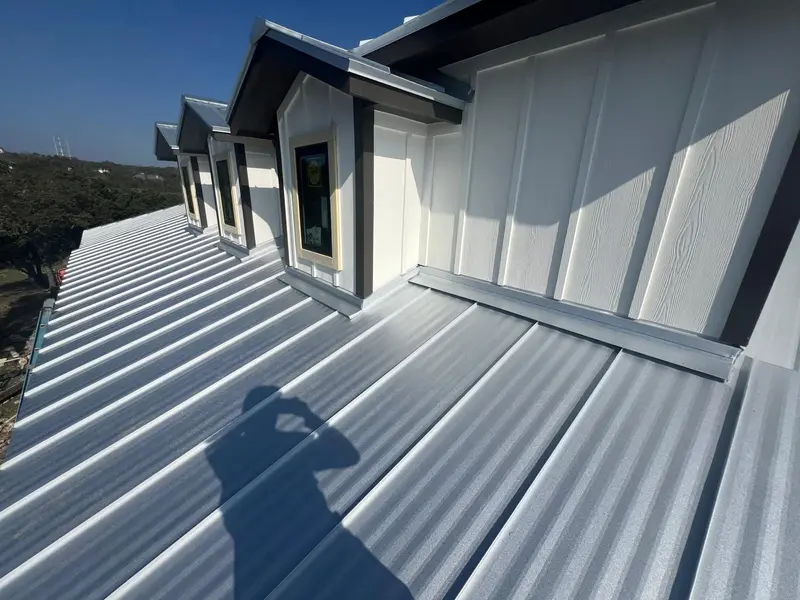
Houston’s residential code sets one minimum slope for all standing seam, 1/4:12 (R905.10.2). Each panel’s own listing sets its real limit: most snap-lock panels are listed at 3:12 and a few lower, while mechanically seamed panels are typically listed below 3:12, some of them only with sealant in the seam.
NRCA writes that architectural metal panel systems, which include both seam types on a plywood deck, “perform well on slopes of 3:12 or greater.” Below that the seam itself has more to do. On sections below 3:12 we install mechanically seamed panels, within the panel’s listing, which we check against your lowest-pitched section.
A mechanical seam is folded shut by a machine. New Tech Machinery: “Mechanical seaming increases panel rigidity for better resistance to high winds and severe weather.” The fold is 90 degrees for a single lock or 180 degrees for a double lock, which Western States, in its double lock comparison, calls “more secure and weather-tight” than single lock (see single lock vs double lock). We install the double lock.
A snap-lock seam is held by the shape of the metal, so every seam has to be fully engaged. New Tech Machinery tells installers: “Ensure seams are tightly snapped and fully engaged for best weather resistance and to prevent disengagement over time.” That is an instruction to the crew, not a prediction about your roof.
Mechanical seam is a harder roof to get wrong quietly. Closing the seam takes the panel maker’s seaming tool and a trained crew, and the machine pass along each seam is a deliberate step that either happened or did not.
We will check your lowest-pitched roof section against the panel’s listing and tell you which seam fits. See standing seam roofing in Houston or call RISE Roofing at (832) 224-3435. We answer 24/7.
A fair mechanical seam vs snap-lock comparison includes what the seamed roof costs you.
That last point is why the installer matters as much as the panel. Ask who runs the seamer, with what machine, and how often that crew seams this panel. Put the same questions to us.
If the right-hand column fits your house on any row, have the seamed roof priced.
| Choose snap-lock if… | Choose mechanical seam if… |
|---|---|
| Your main goal is the look of standing seam. | You want the seam that is usually rated higher at the same clip spacing. |
| Every roof section is at or above the panel’s listed minimum slope (3:12 for most snap-lock panels). | You have low-pitch sections (a porch, patio cover, addition or dormer tie-in). Below 3:12 we install mechanical seam, within the panel’s listing. |
| Your home is inland, away from open water and the coast. | You are near the coast or open water. |
| A lower price matters more to you than a tighter seam. | You are willing to pay more for a machine-folded seam. |
One place the rating can decide the job is the Texas windstorm designated catastrophe area, where we re-roof. TDI says most homes there need a certificate of compliance, which TDI issues, to buy a Texas Windstorm Insurance Association policy, and most roof replacements require an inspection and certificate. The design load for the house may not exceed the panel’s listed rating, so a higher-rated panel leaves more room at the corners and edges. That applies to either seam type.
That area is the 14 first-tier coastal counties, including Galveston, Brazoria and Chambers, plus Harris County properties inside the city limits of La Porte, Morgan’s Point, Pasadena, Seabrook or Shoreacres and east of State Highway 146. Most of Houston is outside it.
We install both and specify mechanically seamed on most of the roofs we build, for the reasons above: Gulf Coast wind exposure, the low-pitch transitions on so many Houston homes, and a seam folded shut by machine. When snap-lock fits the home and the budget, we install it and name it on the quote.
The mechanically seamed panel we install is roll-formed in 24-gauge steel with a 1.5-inch-tall seam, closed as a double lock, folded a full 180 degrees. The ratings above are other companies’ listings, not ours.
Our standing seam installations carry our 10-year workmanship warranty. Our Houston standing seam guide covers gauge, finish and cost, and roof financing through Acorn Finance, a third-party lender, offers $0 down for qualified homeowners.
To have both systems priced for your roof, see standing seam roofing in Houston or request a free estimate, or call RISE Roofing at (832) 224-3435. We are open 24/7.
New Tech Machinery, Mechanical Lock vs. Snap-lock Metal Roof Profiles; Sheffield Metals, snap-lock vs. mechanical seam comparison; Metal Sales, Pros and cons of snap lock standing seam metal roof; McElroy Metal, Metal Roofing in Coastal Areas; Western States Metal Roofing, Snap Lock Standing Seam v. Mechanical Seamed Panels and its double lock comparison; NRCA, Discussing the differences; Houston Residential Code 2021, R905.10.2; Texas Department of Insurance, public windstorm product evaluations (TDI-developed roof-covering evaluations for metal panels, as listed October 1, 2026) and its Product Evaluations, What you need to know about windstorm inspections, What is the Windstorm Inspection Program? and Adopted Building Codes pages. Evaluation figures belong to other companies’ products, not RISE Roofing’s, and are our tally of public records. TDI does not approve, endorse or recommend any product.
On most Houston roofs we think so. At the same clip spacing a mechanically seamed panel is usually rated higher for wind uplift, and its tighter seam suits low-pitch sections. It usually costs more and is harder to repair. If your whole roof is 3:12 or steeper and the home is inland, away from open water and the coast, snap-lock is a sound choice when the look is the goal.
There is no single number. A wind rating is the uplift, in pounds per square foot (psf), that a specific panel is listed to resist at a specific clip spacing on a specific roof deck. At the same clip spacing, a mechanically seamed panel is usually rated higher than a snap-lock panel. Ask for the windstorm product evaluation or test report that covers the panel on your quote.
For many inland Houston homes, yes. Many snap-lock panels are covered by public windstorm evaluations of their own, and on either system the clip spacing has to be set so that the panel’s listed rating covers the design wind load for the house. Mechanical seam is usually rated higher at the same clip spacing.
Usually, yes, and it does on our quotes. Closing every seam with a seaming machine is an extra step, and manufacturers describe mechanically seamed panels as the more expensive standing seam option because of the added labor. Ask us to price both systems for your roof and we will, so you can compare.
Yes, but it takes more work than on a snap-lock roof. The panels are folded together, so a damaged panel has to be unseamed before it can come out. That is a real trade-off, so ask who will handle repairs before you buy.
🔒 Free, no-obligation quote — Price-locked estimate in 24 hrs
Trace your roof on satellite imagery and get a real installed price in under 60 seconds.
Powered by satellite roof measurement technology. No obligation.