Snap-lock, mechanically seamed, and nail strip — what actually separates them, and what the published test data shows.
Most homeowners are quoted “a standing seam metal roof” as though it were one product. It isn’t. The panels can be joined three different ways, and the method changes how the roof is installed, what slope it can go on, and how it is tested. Two roofs can both be sold as standing seam, both carry the same UL classification, and still have tested uplift capacities that differ by a factor of three.
This guide explains the types, shows the published numbers rather than asserting a rule of thumb, and gives you the questions that get a straight answer out of any contractor.
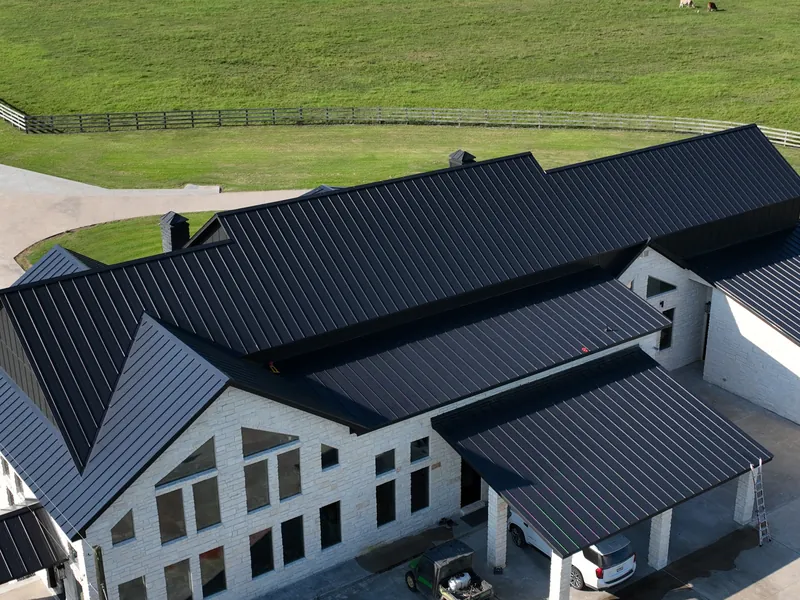
Snap-lock panels have shaped male and female legs. The installer sets the panel over concealed clips and presses the next panel until the legs engage. The Metal Construction Association describes the seaming step plainly in its Roof Seaming Best Practices Guide: “This process is not required with snap-together seam profiles.” No seamer is run along the side lap, which is why the system installs faster and needs no proprietary machine on site.
NRCA classes snap-together systems as standing seam, with one carefully worded caution worth quoting in full: “though snap-together seaming systems are considered standing seams, some have relatively poor water resistance, restricting their use to steep-slope, architectural applications.” The word some is NRCA’s, not ours — it is a warning about particular products, not a verdict on the whole category.
Mechanically seamed panels are set the same way, but the seam is then closed by a machine. MCA’s installation manual: “Mechanical seams are joined together by using hand-seamers, tongs, or electrical seaming devices.” Part of the seam is shaped when the panel is roll-formed, at a factory or on site, and the fold is completed on the roof once the panels are in place.
There is a real engineering consequence, and MCA states it with its own hedges intact: “Mechanically formed seams tend to remain firmly attached to the roof structure. This is because, in many cases, the panel clip is also folded over and becomes part of the rolled seam.” That is the substantive difference — in many mechanically seamed systems the clip is not merely held by the panel, it is folded into the seam and becomes part of it.
Two practical notes. Seamers are usually proprietary to the panel: “Mechanical seamers are normally proprietary to each roof system. This means each roof panel type may require a separate seaming machine, as well as separate tooling, set-up, and adjustments.” And because a breakdown halts the job, MCA advises that “it is always wise to have a back-up seamer available.” Many systems also call for hand crimping at the clips before the powered seamer runs — MCA notes that “many of the available standing seam systems call for hand seaming (or crimping) at clips, followed by mechanical seaming,” and skipping that step is a real installation defect.
A third profile the sales conversation usually skips. Nail strip panels carry an integral fastening flange and are fastened through it, which eliminates separate clips. It is a distinct system with its own listings and its own slope limits, and it should not be confused with either of the above.
A lot of people search for snap-lock vs standing seam, or standing seam vs snap-lock, as though those were two competing products. They are not. Snap-lock is a standing seam system — it is one of the ways a standing seam is closed. NRCA says so directly, and attaches the caveat in the same breath: “though snap-together seaming systems are considered standing seams, some have relatively poor water resistance, restricting their use to steep-slope, architectural applications.”
The comparison that actually means something is snap-lock versus mechanically seamed — two ways of closing the same kind of roof. For that comparison in full, see snap-lock vs mechanical seam. If a quote offers you “standing seam or snap-lock” as if they were alternatives, ask which panel and which seam is in the price. The answer tells you a lot about who you are dealing with.
Within mechanically seamed panels, the seam is described by how far the metal travels. A single lock is mechanically locked at 90°. A double lock adds a further 90° of travel — MCA defines the “180 seam” as “a generic reference to the additional 90° of motion that material travels.” Petersen’s code-listed line makes the same split: Tite-Loc seams “mechanically locking at 90 degrees,” Tite-Loc Plus “mechanically locking at 180 degrees.”
Here is the part the marketing rarely mentions. In ICC-ES evaluation report ESR-4173, the 90° Tite-Loc, the 180° Tite-Loc Plus and the PAC-150 Double Lock are all listed at the same minimum slope. A double lock is a more enclosed seam and the right call on many low-slope roofs, but it is not automatically rated higher than a single lock, and how many passes of the seamer it takes is a property of the equipment rather than of the seam.
This is the single most useful thing on this page.
Class 90 sounds like a capacity. It is not. It is a pass/fail classification: the assembly is subjected to a set sequence — roughly 48.5 psf of pressure from below combined with 56.5 psf of vacuum from above, a 105 psf differential — and, as ATAS International states in its technical bulletin on wind uplift, “the test is not run to failure, only to the specified limit.”
So a Class 90 label tells you a roof cleared a bar. It does not tell you by how much, and it cannot rank two roofs that both cleared it. McElroy Metal lists UL 580 Class 90 for both its snap-lock Medallion-Lok and its mechanically seamed Maxima panels — which is precisely why that label cannot tell you which of the two is stronger.
The test that produces an actual number is ASTM E1592, which is run to failure and reports an ultimate load for a specific assembly at a specific support spacing.
Below is McElroy Metal’s own published ASTM E1592 data, all 24-gauge, so the comparison is like for like. Figures are ultimate uplift in pounds per square foot at the stated support spacing.
| Panel (24 ga) | Seam type | 1 ft span | 2 ft span | 5 ft span |
|---|---|---|---|---|
| Medallion-Lok 16″ | Snap-lock | 116.13 psf | 88.40 psf | 50.27 psf |
| Maxima 324 | Mechanically seamed | 126.0 psf | — | — |
| Maxima 216 | Mechanically seamed | 344.9 psf | 221.7 psf | 88.4 psf |
Read those three rows together, because the story is in the contrast:
The honest conclusion is that there is no fixed ratio between the two seam types. Anyone who tells you mechanically seamed is “three times stronger” as a general rule is quoting one pairing and presenting it as a law. What the data supports is narrower and more useful: the strongest assemblies in the catalogue are mechanically seamed, but a specific mechanically seamed panel can sit close to a specific snap-lock one. You have to ask about the assembly, not the category.
Look along a single row of that table. The same Maxima 216 panel — one product, one gauge, one seam — tested at 344.9 psf over 1-foot supports and 46.8 psf at 7 ft 6 in. That is a 7.4× swing driven by nothing but how far apart the supports are.
This is why a quote that names only a panel is incomplete. In both snap-lock and mechanically seamed assemblies the roof is anchored to the deck at discrete clips at a specified spacing, each with a specified number of screws — ICC-ES listings spell this out to the inch and the fastener. Tightening clip spacing in the perimeter and corner zones, where uplift is highest, is one of the most effective things an installer can do, and it is invisible once the roof is finished.
The “snap-lock needs 3:12” rule is repeated constantly and it is a misreading. The 3:12 figure in IBC 1507.4.2 applies to “lapped, nonsoldered seam metal roof panels without applied lap sealant” — that is exposed-fastener panel, not standing seam.
For standing seam the code is explicit and makes no distinction by seam type: “The minimum slope for standing-seam metal roof panel systems shall be one-quarter unit vertical in 12 units horizontal (2-percent slope).”
Two things follow. First, the governing number in practice is the manufacturer’s listing for the specific panel, which is often steeper than code — Petersen’s snap-lock Snap-Clad, for instance, is listed at a 2:12 minimum in ESR-4173. Second, code is a floor, not a target. NRCA recommends more: “For metal panel roof systems, NRCA recommends slopes of 1/2:12 or more for structural panel systems and 3:12 or more for architectural panel systems” — and states the reason: “Prescribed requirements are minimums, and they may not be adequate for achieving watertight roof systems.” On sections below 3:12 we install mechanically seamed panels, within the manufacturer’s listing for that panel.
NRCA also draws the distinction that matters most on a low roof: architectural metal panel systems “typically are designed to shed water rapidly over the panels’ surface, so the seams are not necessarily watertight.” The flatter your roof, the less you can rely on water simply running off, and the more the seam itself has to do.
Every metal roof expands and contracts, and the assembly has to let it. MCA: “Fasteners, clips, and perimeter connections should be designed and installed to accommodate the anticipated thermal movement.”
Both systems accommodate movement — they do it by different mechanisms, and neither is incapable of it. Petersen states of its snap-lock Snap-Clad that “a concealed fastener clip system allows for thermal expansion/contraction while providing extraordinary hold-down strength.”
How much movement? The coefficient of linear thermal expansion is 0.0000065 per °F for galvanized or Galvalume steel and 0.0000128 per °F for aluminum — aluminum moves roughly twice as much as steel for the same temperature change. On that basis a 30-foot steel panel changes about 1/4 inch over a 100 °F change in panel temperature. Panel temperature is not air temperature: MCA notes surface temperature “may be more than 100 degrees higher than ambient air temperature.”
On oil canning — the visible waviness in flat areas of panel — MCA is clear that it “is generally an aesthetic issue. Structural integrity is typically not affected,” that it “can occur in any type of metal panels,” and that a real driver is restrained movement: “if panel expansion/contraction is inhibited by perimeter flashing conditions or inadvertent ‘dual pinning’ at other details, the result can be seen as oil canning.” MCA does not identify snap-lock versus mechanically seamed as a cause or a differentiator.
We install both systems, and we specify mechanically seamed on most of the roofs we build. That is a judgement about our market, not a claim that snap-lock is defective:
There are roofs where snap-lock is the sensible specification, and we will say so when it is. What we will not do is quote “standing seam” without telling you which system is in the price. Our snap-lock vs mechanical seam guide covers how to choose between them.
If a contractor cannot answer the first two, the rest of the quote is guesswork. For how these choices land on price, see our metal roof cost guide; for the local buying picture, our Houston standing seam guide; and for how metal compares with asphalt, metal roof vs shingles.
Want to know which system belongs on your roof? Call RISE Roofing at (832) 224-3435 for a free inspection, and we will tell you what we would specify and show you the data behind it.
Metal Construction Association, Roof Seaming Best Practices Guide, Standing Seam Roof Clips Best Practices Guide, and Metal Roof Installation Manual (Ch. 12, Ch. 15); NRCA slope guidance via Professional Roofing; ICC-ES Evaluation Report ESR-4173 (Petersen); McElroy Metal published ASTM E1592 test bulletins for Medallion-Lok and Maxima; ATAS International Tech Tips, Wind Uplift; International Building Code 1507.4.2 / IRC R905.10.2. Test values are the manufacturer’s published figures for those specific assemblies and are not transferable to other products.
Standing seam panels are grouped by how the side seam is closed. Snap-lock panels press together by hand on the roof and need no seaming machine. Mechanically seamed panels are closed with a powered seamer that folds the seam 90 degrees (single lock) or a further 90 degrees (double lock). Nail strip, also called fastener flange, fastens through an integral flange instead of separate clips. Panels are also classified by metal, gauge, panel width, leg height, and rib profile.
Not automatically. Wind uplift is a property of the whole assembly — panel profile, gauge, clip type, clip spacing, deck and support spacing — rather than of the seam by itself. In McElroy Metal's published ASTM E1592 tests, the snap-lock Medallion-Lok in 24 gauge reached 116.13 psf ultimate over 1-foot supports while the mechanically seamed Maxima 216 reached 344.9 psf in the same span, about three times higher. But McElroy's mechanically seamed Maxima 324 reached 126.0 psf at that same span, only about 8 percent above the snap-lock panel. The seam type alone does not tell you the number.
The difference is how far the metal is folded. A single lock is mechanically locked at 90 degrees; a double lock adds a further 90 degrees of travel, which is why it is also called a 180-degree seam. In Petersen's code-listed panels the two are recognised separately, but ICC-ES evaluation report ESR-4173 assigns Tite-Loc at 90 degrees and Tite-Loc Plus at 180 degrees the same minimum slope, so a double lock is not automatically rated higher than a single lock.
Building code sets one-quarter unit vertical in 12 units horizontal — a 2 percent slope — as the minimum for standing seam metal roof panel systems, and it does not distinguish snap-lock from mechanically seamed. The often-repeated 3:12 minimum comes from a different code provision covering lapped, nonsoldered seam panels without lap sealant, which is exposed-fastener panel rather than standing seam. In practice the manufacturer's listing for the specific panel governs, and NRCA recommends more slope than code: 1/2:12 or more for structural panel systems and 3:12 or more for architectural ones.
No. UL 580 Class 90 is a pass or fail classification, not a wind speed and not a measured capacity. The assembly is subjected to a set sequence — roughly 48.5 psf of pressure from below combined with 56.5 psf of vacuum from above, a 105 psf differential — and the test is stopped at that limit rather than run to failure. Two roofs can both carry Class 90 and still have very different tested capacities, which is why we look at ASTM E1592 data for the specific assembly.
Snap-lock is a type of standing seam, not an alternative to it. NRCA classes snap-together seaming systems as standing seams, while noting that some have relatively poor water resistance, which restricts those to steep-slope architectural applications. The comparison worth making is snap-lock versus mechanically seamed — two ways of closing the same kind of roof.
Both snap-lock and mechanically seamed are used on homes, and the right one depends on the specific roof rather than on a general rule. We install both and specify mechanically seamed on most of the roofs we build — because of low-slope transitions, Gulf Coast exposure, and because the highest tested assemblies in a manufacturer’s catalogue are mechanically seamed. We do not quote an industry market-share figure, because no roofing association publishes one.
We install both snap-lock and mechanically seamed standing seam, and we specify mechanically seamed on the majority of the roofs we build. We choose based on the slope of your roof, the panel and clip assembly the manufacturer lists for it, and the exposure of the site. Call (832) 224-3435 and we will tell you which system we would put on your roof and why.
🔒 Free, no-obligation quote — Price-locked estimate in 24–48 hrs
Trace your roof on satellite imagery and get a real installed price in under 60 seconds.
Powered by satellite roof measurement technology. No obligation.